
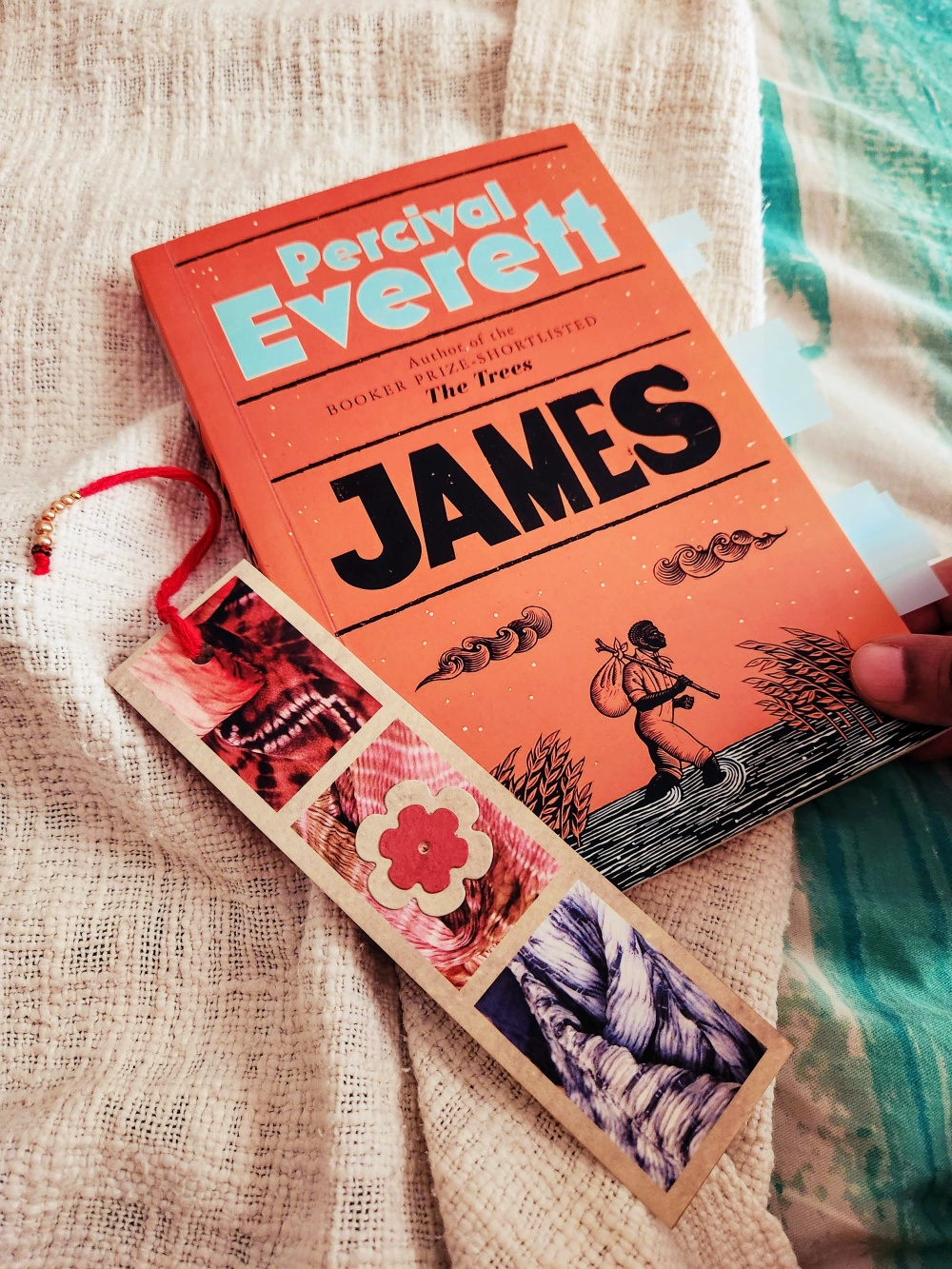
With my pencil, I wrote myself into being. —James, Percival Everett
I knew of Mark Twain, of course, but I had never read any of his books. With James by Percival Everett getting such rave reviews, it was a great time to go back to the roots.
James is a reimagining of Mark Twain’s Adventures of Huckleberry Finn, told from the perspective of Jim, the enslaved man who accompanies Huck down the Mississippi River. Percival Everett flips the narrative by centering Jim’s voice and experiences in his book, giving us a profound narrative exploring themes of race, identity, and freedom.
Books that are deemed classics have often left out the POVs of the underserved. Revisiting those stories from the perspective of minor characters gives us a chance to reexamine the narratives that shape our understanding of history. James does that in a way that makes it relevant even today.
Although the book can be read without having read Mark Twain’s classics, the context helped me better understand it.
Author Percival Everett
I did not look away. I wanted to feel the anger. I was befriending my anger, learning not only how to feel it, but perhaps how to use it.
Percival Everett is an acclaimed American novelist, short story writer, and poet known for his incisive explorations of race, identity, and culture. Born in Fort Gordon, Georgia, Everett has authored over 30 works, including Erasure, So Much Blue, and The Trees, which was shortlisted for the Booker Prize.
His writing blends satire, humor, and philosophical depth, challenging readers to question societal norms and literary conventions. A distinguished professor of English at the University of Southern California, Everett’s works are celebrated for their intellectual rigor and innovative storytelling.
His novel James further cements his reputation as a master of reinvention and social critique. Everett’s contributions to literature have earned him numerous awards and a dedicated following.
Book Review James by Percival Everett
“…but where does a slave put anger?”
The novel follows James, an enslaved man, as he navigates the treacherous landscape of the antebellum South, trying to find his voice and to live in freedom. Unlike Twain’s Jim, who is on the sidelines as a secondary character, Everett’s James is sharp, resourceful, and deeply introspective.
The story retains the framework of Huck and Jim’s journey but delves into the horrors of slavery, survival, and the complexities of human relationships. The writing is a mix of humour and biting social commentary.
The story starts off in an idyllic town, where Jim goes about his day. James decides to run away from his owner after finding out she is planning to sell him to another plantation, thereby separating him from his wife and daughter. He plans to return to buy them from her. On his way, he meets Huckleberry Finn—a White boy running away from an abusive father.
Good ain’t got nuttin’ to do wif da law. Law says I’m a slave.
Huck and James agree to travel together. As in the original story by Twain, Huck learns to view Jim as human by and by. Similarly, in this book, Huck questions the world around him and learns what it’s like to be a part of James’s.
The book starts off by describing the life of a slave in a small household. Jim—later reclaiming his name to James—reveals how enslaved people endure constant degradation: treated as property, subjected to violence, and severed from family at any moment. Their lives depend on someone else’s whims.
I can’t feed your fantasy that you’re a good, kind master. No matter how gentle you were when you applied the whip, no matter how much compassion you showed when you raped.
We also learn that the slaves have a language they use in front of the White people, which seems broken and unformed, while the language they use when they are amongst themselves is more refined. This is to prove to their masters that they are not intelligent enough to rebel. The first time you hear the change in James’s language, it seems funny, but the shift in his speech shows how language is used as both a survival tool and a subversive act. At the end, the Judge’s panic at James’ literacy instead of his armed resistance shows how whiteness fears Black autonomy more than violence.
Control is enforced through terror in this era. The lynching of Young George for stealing a pencil isn’t about the pencil but about reinforcing power. Everett draws parallels to modern micro-aggressions, where marginalised groups still code-switch to navigate oppressive systems. They must present a more docile version of themselves and always appear non-threatening. Slaves, or minorities, cannot express their anger without it becoming a threat to security as seen by the majority. They need to repress it, lest they face retribution or are violently suppressed.
Folks be funny lak dat. Dey takes the lies dey want and throws away the truths dat scares ‘em.
Even education, a path to liberation, is weaponised; slaveowners and authoritarians fear literacy, so they try to ban books and attack inclusive education.
The novel also dissects the hypocrisy of benevolent racism. White allies like Emmet, who shakes James’s hand, ultimately uphold the system. Their allyship crumbles when challenged, revealing their self-interest beneath the performative goodwill. This politeness lulls Jim into feeling safe, but he can sense an underlying uneasiness in his behaviour. Even in the present day, many people who said they were against slavery or oppression but profited from it don’t feel guilty as they thought their intentions were good or that they personally had no part in it.
A man who refused to own slaves, but was not opposed to others owning slaves was still a slaver, to my thinking.
Similarly, many slaves made a distinction between good and bad masters, without comprehending fully that they were masters nonetheless. Enslaved people like Luke internalise oppression, even betraying others to curry favour. Being power-adjacent can have short-term advantages, but eventually, they will come for you.
James’s journey underscores that freedom is just an illusion under systemic racism. Even Norman, who passes as white, lives in terror of exposure. It reminded me of the story of Belle, who became the personal librarian to JP Morgan. Her story is told in the book The Personal Librarian by Victoria Murray and Marie Benedict. She lived in constant fear of being exposed and severely punished.
What you’re saying is that if someone pays you enough, it’s okay to abandon what you have claimed to understand as moral and right.
James’s defiant declaration of his name at the end echoes Sidney Poitier’s iconic line in the movie In the Heat of the Night, “They call me Mr. Tibbs!” asserting dignity in a world that denies it. This book is not shy to talk about America’s unresolved legacies, demanding readers to confront how deeply the past permeates the present.
Religion is just a controlling tool they employ and adhere to when convenient.
Verdict: Read
Book Review: Mark Twain’s The Adventures of Tom Sawyer and Adventures of Huckleberry Finn
Right is right, and wrong is wrong, and a body ain’t got no business doing wrong when he ain’t ignorant and knows better.

Mark Twain’s The Adventures of Tom Sawyer (1876) and its sequel, Adventures of Huckleberry Finn (1884), are two of the most iconic works in American literature. Both novels are set in the fictional town of St. Petersburg, Missouri, along the Mississippi River. They explore themes of childhood, freedom, morality, and American societal norms in the 19th century through the eyes of their young protagonists.
While Tom Sawyer is a lighthearted tale of mischief and youthful exuberance, Huckleberry Finn delves deeper into themes of morality, freedom, and racial injustice, making the two novels complementary yet distinct.
Tom Sawyer follows the escapades of Tom, a clever and imaginative boy. Through his adventures—whether whitewashing a fence, hunting for treasure, or exploring caves—Twain paints a vivid picture of childhood freedom and the joys of rebellion against authority. The novel is filled with humor and nostalgia.
In contrast, Huckleberry Finn is a more mature and introspective work. Narrated by Huck, a boy fleeing his abusive father, the story becomes an exploration of friendship and ethics. Huck’s journey down the Mississippi River with Jim, an escaped enslaved man, forces him to confront societal norms and his own conscience. Twain’s use of regional dialects and his unflinching critique of racism make the novel both groundbreaking and controversial.
The less there is to justify a traditional custom, the harder it is to get rid of it
Mark Twain’s The Adventures of Tom Sawyer and Adventures of Huckleberry Finn are often scrutinised for their portrayal of race and racism, particularly in the latter. In Huckleberry Finn, Twain uses the character of Jim to highlight the dehumanising effects of slavery and the moral contradictions of a society that claims to be civilised yet upholds such an institution.
…in order to make a man or a boy covet a thing, it is only necessary to make the thing difficult to attain.
Through Huck’s evolving relationship with Jim, Twain critiques the racism ingrained in American culture, as Huck learns to see Jim not as property but as a human being, deserving of freedom and dignity. However, the novel’s use of racial slurs and stereotypical depictions, while reflective of the era’s language and attitudes, can be jarring and offensive, especially if you are listening to the audiobook. This one wouldn’t be recommended for kids unless they’re old enough to understand the context.
Human beings can be awful cruel to one another.
Twain’s intent was not to endorse racism but to expose its absurdity and cruelty, using satire and the moral struggles of its characters to challenge readers to confront their own prejudices and the legitimacy of laws that perpetuate injustice.
Author Mark Twain
When one writes a novel about grown people, he knows exactly where to stop – that is, with a marriage; but when he writes about juveniles, he must stop where he best can.
Mark Twain (1835–1910), born Samuel Langhorne Clemens, was an American writer, humorist, and social critic, often called the father of American literature. He grew up in Hannibal, a Mississippi River town that inspired the settings of his most famous works.
Twain began his career as a printer, riverboat pilot, and journalist, adopting his pen name from a riverboat term meaning “two fathoms deep.” Known for his wit, satire, and keen observations of human nature, Twain wrote extensively about American life, tackling themes like racism, morality, and societal hypocrisy.
If you tell the truth you do not need a good memory!
Verdict: Read
Note: Some links are part of an affiliate program, which means that if you click on a link and buy something, I might receive a percentage of the sale at no extra cost to you.





Leave a Reply