

मुश्किलें सिर्फ इसलिए आती हैं, ताकि आप उन्हें तबाह न करके, पार कर सकें।
I never had Hindi as a subject in school till I was in 9th standard, CBSE Board. We spoke Hindi at home, but it was simple vocabulary mixed with English. Suddenly, I was faced with Kabir’s couplets and Munshi Premchand’s works. I struggled to pass my 10th Board Exams and never thought I would reread these works. I’m glad that plan didn’t work out!
Indian literature is a treasure trove of stories that reflect the sociocultural fabric of the nation. Munshi Premchand has captured its essence, and even after almost 100 years, his works continue to resonate with readers for their realism, emotional depth, and timeless themes highlighting the struggles of the common man.
Dreams are not what we see when we sleep, dreams are what keep us awake.
I steeled myself and decided I needed to read more diverse books from my own country. A few years ago, I picked up Godaan (an English translation) and listened to Gaban’s Hindi audiobook this year. These masterpieces of Hindi literature offer profound insights into rural life, social injustices, and human desires.
Their compelling narratives, unforgettable characters, and enduring relevance shouldn’t have surprised me. I was surprised at how easy it was to follow the story and language. They talk about the complexities of human desires, societal pressures, and the quest for dignity that are relevant now more than ever.
Here are my thoughts on reading two of his most celebrated novels—Godan and Gaban.
Author Munshi Premchand
What the world calls sorrow is really joy to the poet.
Munshi Premchand (1880–1936) was a renowned Indian writer and one of the most celebrated figures in Hindi and Urdu literature. Born as Dhanpat Rai Srivastava in Lamhi, a small village near Varanasi, he adopted the pen name Premchand.
Known for his simple yet profound writing style, Premchand’s works talked about social realities, poverty, caste issues, and the struggles of the common man.
He wrote over 300 short stories and several acclaimed novels, including Godan, Nirmala, and Gaban. His stories often focused on rural life, social injustice, and the plight of farmers and marginalised communities. Premchand was also a pioneer in moving away from romanticism to realism in Indian literature.
Apart from his literary contributions, Premchand was a staunch supporter of India’s freedom movement. His legacy continues to inspire, and he is often referred to as the Upanyas Samrat (Emperor of Novels) in India.
Book Review of Godan by Munshi Premchand: A Tale of Struggle, Sacrifice, and Human Resilience
जीत कर आप अपने धोखेबाजियों की डींग मार सकते हैं, जीत में सब-कुछ माफ है। हार की लज्जा तो पी जाने की ही वस्तु है।
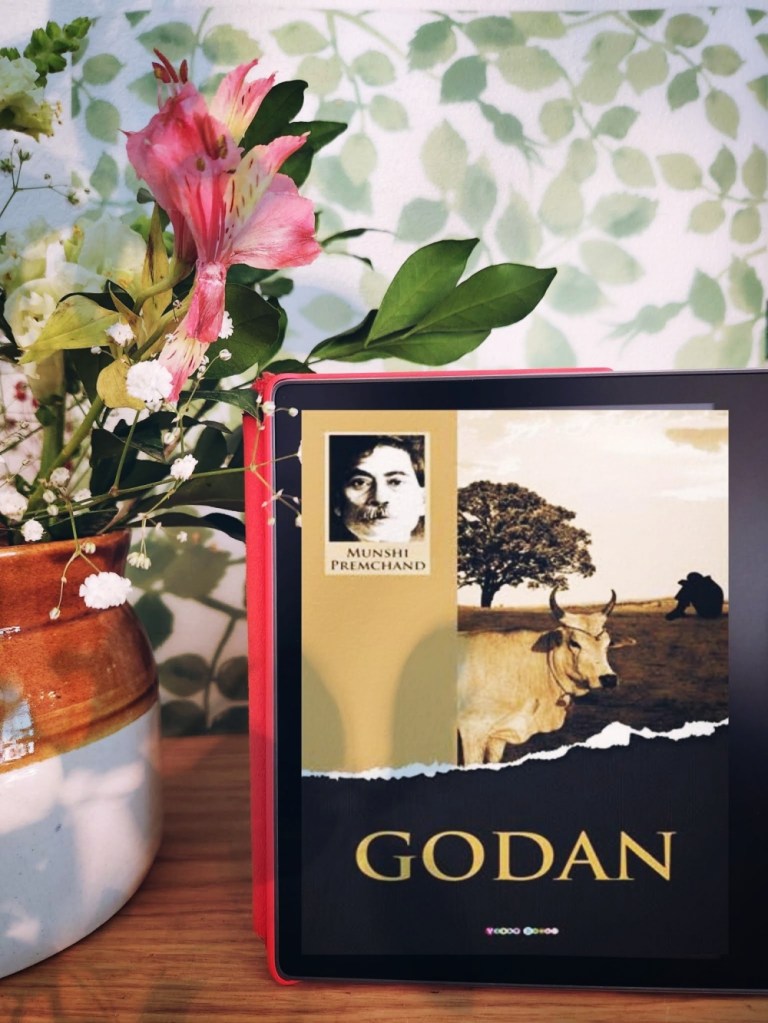
Munshi Premchand’s Godan (The Gift of a Cow) is one of his most renowned works. It was first published in 1936 and gives us a look into the socio-economic struggles of rural India. It was hard for me to read about the vivid characters who exposed the harsh realities of poverty, caste oppression, and exploitation. I felt a sense of helplessness at the cruelty of people and how the oppressed have no choice but to get used to it or succumb to it.
Can a two-eyed man ever feel the hurt that a one-eyed man feels at the taunt of being called a one-eyed man?
The novel revolves around the life of Hori, a poor farmer in a small village whose sole dream is to own a cow—a symbol of prosperity and dignity. He feels that even to dream of anything more is ridiculous. However, this seemingly simple aspiration becomes a source of endless hardship as Hori grapples with debt, societal pressures, and the exploitative practices of moneylenders and landlords.
Hori’s relentless struggle to repay debts and his eventual downfall highlight the vicious cycle of exploitation faced by farmers. The portrayal of the zamindari system and the greed of moneylenders is heartbreaking.
The book also tells us about the struggles of other characters, such as his resilient wife Dhania, a lower caste woman who struggles and survives through every hardship thrown her way. She strives for self-respect even against all odds.
सुख के दिन आयें, तो लड़ लेना; दुख तो साथ रोने ही से कटता है।
Premchand’s writing is marked by its simplicity and emotional depth. Its themes of inequality, human suffering, and resilience hold true across time and cultures. The pace of the story is slow, and there are a lot of detailed descriptions of rural life, so read this at leisure, taking in all the elements as you immerse yourself in the imagery.
बूढ़ों के लिए अतीत के सुखों और वर्तमान के दुःखों और भविष्य के सर्वनाश से ज्यादा मनोरंजक और कोई प्रसंग नहीं होता।
Book Review of Gaban by Munshi Premchand: A Tale of Greed, Morality, and Societal Pressures
उदासों के लिए स्वर्ग भी उदास है।

Published in 1931, Munshi Premchand’s Gaban (Embezzlement) is another look at human desires, societal expectations, and the consequences of moral compromise. Set in colonial India, the novel follows Ramanath, whose relentless pursuit of materialism and societal approval leads to his downfall.
Gaban’s relatable characters make it relevant even today. I see the same pressures of modern life to project a certain image to society and the timeless struggle between ambition and ethics.
जो काल से भी नहीं डरते, वे भी लज्जा के सामने खड़े होने की हिम्मत नहीं करते।
At its core, Gaban critiques the destructive pull of materialism. Ramanath resorts to embezzlement to maintain a facade of success and satisfy his wife Jalpa’s unspoken desires. While Jalpa never explicitly demands jewellery, her subtle appreciation for it fuels Ramanath’s obsession.
This dynamic is contrasted with the austere lives of Ramanath’s parents, Munshi Dayanath and Rameshwari, who embody frugality and moral integrity. I could feel the sadness of Rameshwari when she talks about how she never got anything from her husband in the way of gifts.
Jalpa emerges as one of the novel’s most nuanced characters. Initially portrayed as a petulant wife fixated on trivial things, her character evolves to reveal a stronger moral character who values respect. Despite her initial indulgence, she becomes a pillar of resilience, willing to endure suffering and even confess to Ramanath’s crimes to uphold righteousness. Her transformation highlights the complexities of gender roles in a patriarchal society, where women are often blamed for men’s failures but are also the unsung heroes who hold families together.
ज हँ एक बार प्रेम ने वास किया हो; वहाँ उदासीनता और विराग चाहे पैदा हो जाए, हिंसा का भाव नहीं पैदा हो सकता।
The novel also introduces other strong female characters, such as Ratan, Zohra, and Jaggo, who navigate their struggles with grace and determination. Ratan, a magnanimous friend to Jalpa, faces her own battles when her husband’s death leaves her vulnerable to property disputes. These women stand in stark contrast to their flawed male counterparts.
ज ब हम कोई काम करने की इच्छा करते हैं, तो शक्ति आप ही आ जाती है।
Premchand masterfully portrays Ramanath’s internal conflict, capturing his desperation, shame, and eventual realisation of his mistakes. The novel also shows us a world with broader societal issues, such as police corruption, bureaucratic inefficiency, and the entrenched caste system.
Despite his moral failings, Ramanath’s eventual remorse and Jalpa’s unwavering support offer a glimmer of hope. Their journey to rebuild their lives lets us know that it is never too late for change.
The final scene is heartbreaking but also a testament to the fact that life goes on through hardship. As Rama says, he couldn’t leap to save the past because his responsibilities to the future held him back.
बहुधा हमारे जीवन पर उन्हीं के हाथों कठोरतम आघात होता है, जो हमारे सच्चे हितैषी होते हैं।
Verdict: Must Read
Note: Some links are part of an affiliate program, which means that if you click on a link and buy something, I might receive a percentage of the sale at no extra cost to you.





 Love, Life, & Beyond
Leave a comment