

“People aren’t so bad, really,” she said. “It’s what the world does to them.”
I had read the Hunger Games trilogy when they first came out over 10 years ago, and I remember thinking that that’s the kind of female lead books should have. (Twilight was published just before and I felt that is the kind of female lead no book should have.) This is one series that gets better when you re-read it.
I had been wanting to read the trilogy again but waited since I found out that there will be more books. Although the prequels are good (and can even be read as standalones), they work well together to give you a fuller understanding of the characters and the setting of the original trilogy.
As far as chronology goes, I will recommend you stick to the order of publication rather than timeline. The same goes for the movies. Jennifer Lawrence was the perfect Katniss and Woody Harrelson the perfect Haymitch. The Sunrise on the Reaping movie comes out this year and I can’t wait to watch it.
“Happy Hunger Games! And may the odds be ever in your favour!”
Author Suzanne Collins
We never, none of us, had any choices.
Suzanne Collins is an American author and television writer, known for The Hunger Games trilogy and The Underland Chronicles. Before writing, she spent years working in children’s television, crafting engaging stories for networks like Nickelodeon.
The inspiration for her dystopian masterpiece stems not only from her late-night channel-surfing but also from her father’s experiences serving in the Vietnam War. This made her keenly aware of the psychological toll of combat. She has won numerous literary accolades for her work.
All of the Hunger Games series books have been adapted as movies, with the final one, Sunrise on the Reaping, releasing in November 2026.
Book Review: The Hunger Games Trilogy by Suzanne Collins
“I guess there isn’t a rule book for what might be unacceptable to do to another human being.”
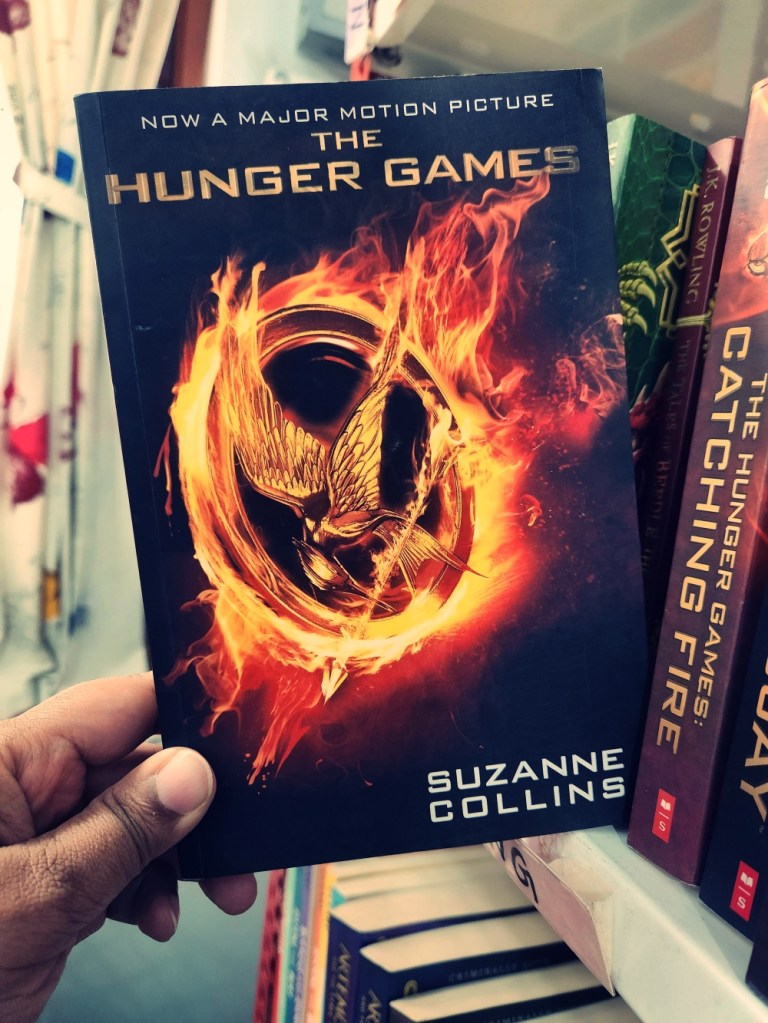

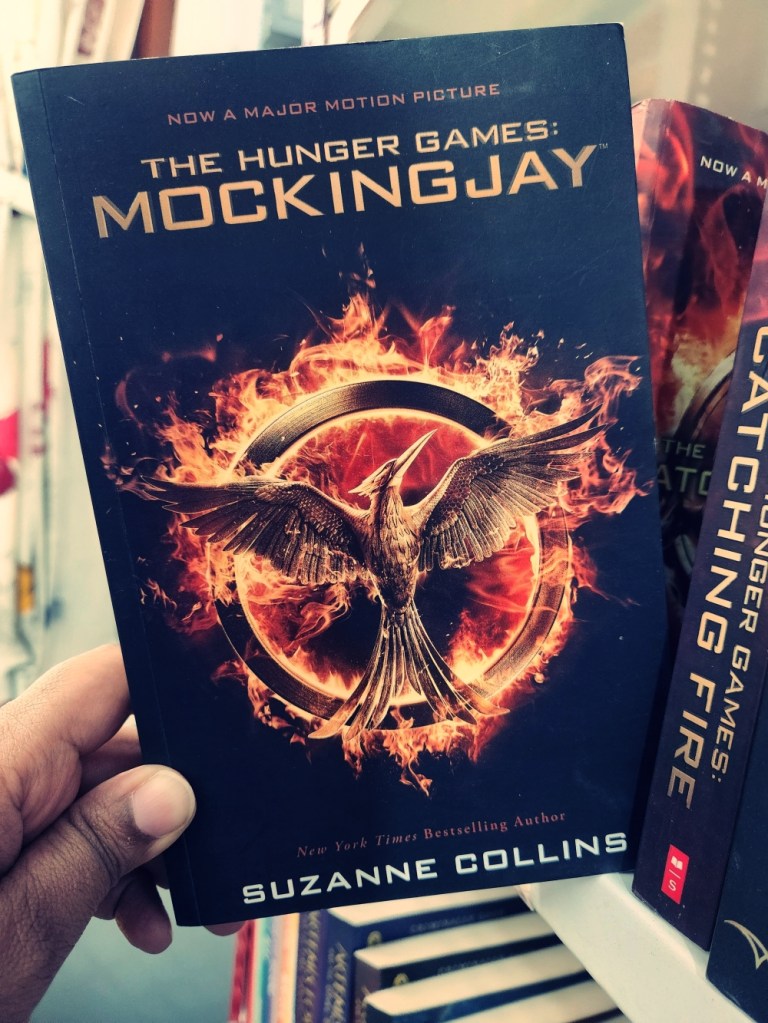
Suzanne Collins’ The Hunger Games trilogy—comprising The Hunger Games, Catching Fire, and Mockingjay—is categorised as Young Adult dystopian fiction. However, I would also recommend it to adults as a sharp political thriller that demands to be taken seriously as it reflects the times we live in.
The premise is instantly gripping: In the ruins of North America lies Panem, a nation where the wealthy, glittering Capitol maintains control over 12 impoverished districts by forcing them to send one boy and one girl to fight to the death in an annual televised event. But the series is not just about the thrill of survival in the arena. It is a tale of how systemic power operates, how media shapes public perception, and how armed conflict inevitably breaks the human spirit.
“It’s to the Capitol’s advantage to have us divided among ourselves.”
We follow the protagonist, Katniss Everdeen. She is not heroic by any means. She is just looking to survive and put food on the table for her family after their father passes away. She volunteers as a tribute to the Hunger Games to protect her younger sister, Prim. Once there, she does everything she can to survive so she can return to her sister. But her reluctance to play the mind games of the Capitol and accept their brutality, transforms her into the face of a revolution.
Gale is her friend in District 12 and both of them eke out a living illegally hunting outside the district boundaries. While Katniss is merely trying to deal with life, Gale is the one who questions why should they live like this? Peeta Mellark is the baker’s boy chosen as the male tribute alongside her. To increase their chances of survival in the arena, they must appeal to the entertainment-hungry Capitol. Their projected love story becomes something even the rich can empathise with.
“At some point, you have to stop running and turn around and face whoever wants you dead. The hard thing is finding the courage to do it.”
In Catching Fire, when the victors are called for the 2nd time, Katniss realises that the Games will never end. Her trauma and grief will always be used as a commodity to the Capitol’s advantage. When she and Peeta are called to compete again, her only focus is to help Peeta survive. Strangely, some other competitors seem to be helping them in the arena. At the end, we find that the revolution has begun in earnest.
We continue following the revolution in Mockingjay, where things are not as ideal as expected. While she is at District 13, she realises that power works the same everywhere. She is a tool to be used. No matter your side, no one comes out of a war victorious.
The characters and situations depicted are not just incidental. They make you think of aspects of human nature. The grotesque, superficial excess of the Capitol mirrors extreme global wealth inequality, while the gamification of tragedy asks hard questions about our own desensitisation to televised violence.
Instead of offering a triumphant, neat resolution wrapped in a bow, the books deliver a bleak, honest depiction of the aftermath of war. There are no clean victories or untarnished heroes. Characters are left permanently scarred, both physically and psychologically, forced to live with the heavy consequences of their actions.
Book Review: The Ballad of Songbirds and Snakes
“You’ve no right to starve people, to punish them for no reason. No right to take away their life and freedom. Those are things everyone is born with, and they’re not yours for the taking. Winning a war doesn’t give you that right. Having more weapons doesn’t give you that right. Being from the Capitol doesn’t give you that right. Nothing does.”
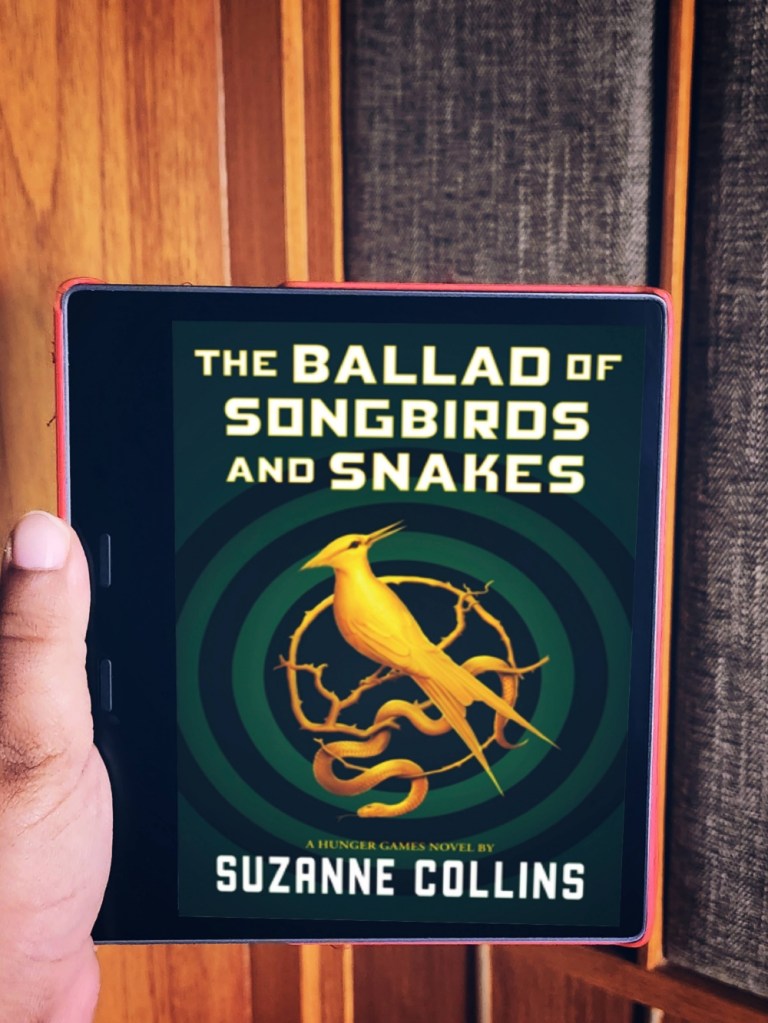
The Ballad of Songbirds and Snakes is a prequel to the Hunger Games series. It centers around the origins of Coriolanus Snow, who becomes the tyrannical President of the Capitol. It is set 64 years before Katniss Everdeen volunteers as tribute. We return to the 10th annual Hunger Games. It is a time when the Capitol is still recovering from the war and the Games themselves are a crude, unpopular punishment rather than a glittering spectacle shown in the original trilogy.
At eighteen, Coriolanus is an ambitious, calculating, yet impoverished student desperate to restore his family’s former glory. His cousin is the voice of reason and kindness in his life. It is the first time Capitol students will be assigned as mentors to the tributes. Their victory will lead to career opportunities for students.
When he is assigned to mentor Lucy Gray Baird, the charismatic, musical tribute from District 12, he takes his role seriously but also recognises the cruelty of her situation. The narrative then shows how someone can spin a complex web of manipulation and toxic ambition. You want to root for him, but you also know what he will become.
“I think there’s a natural goodness built into human beings. You know when you’ve stepped across the line into evil, and it’s your life’s challenge to try and stay on the right side of that line.”
The book does not romanticise Snow, nor does it show him as a misunderstood villain. Instead, we see how his decisions and self-serving choices make him into what he is. He knows what cruelty means and what kindness does. He sees through the shortcomings of the Capitol. Through Snow’s internal monologue, we see how he rationalises every choice he makes; how he justifies his betrayal and cruelty under the pretext of order and survival. We cannot just excuse his actions as those of an impoverished and desperate man. Even his love for Lucy is more possessive. He wants to control her so she can benefit him.
This book gives us an insight into how the Games were meticulously engineered over time to be used as a weapon of psychological control, rather than just a source of punishment for rebellion. It was not just the Districts who were unhappy, but people in the Capitol also lived in fear. That fear was the eventual downfall of the Empire.
“That is the thing with giving your heart. You never wait for someone to ask. You hold it out and hope they want it”
Book Review: Sunrise on the Reaping
“You were capable of imagining a different future. And maybe it won’t be realized today, maybe not in our lifetime. Maybe it will take generations. We’re all part of a continuum. Does that make it pointless?”
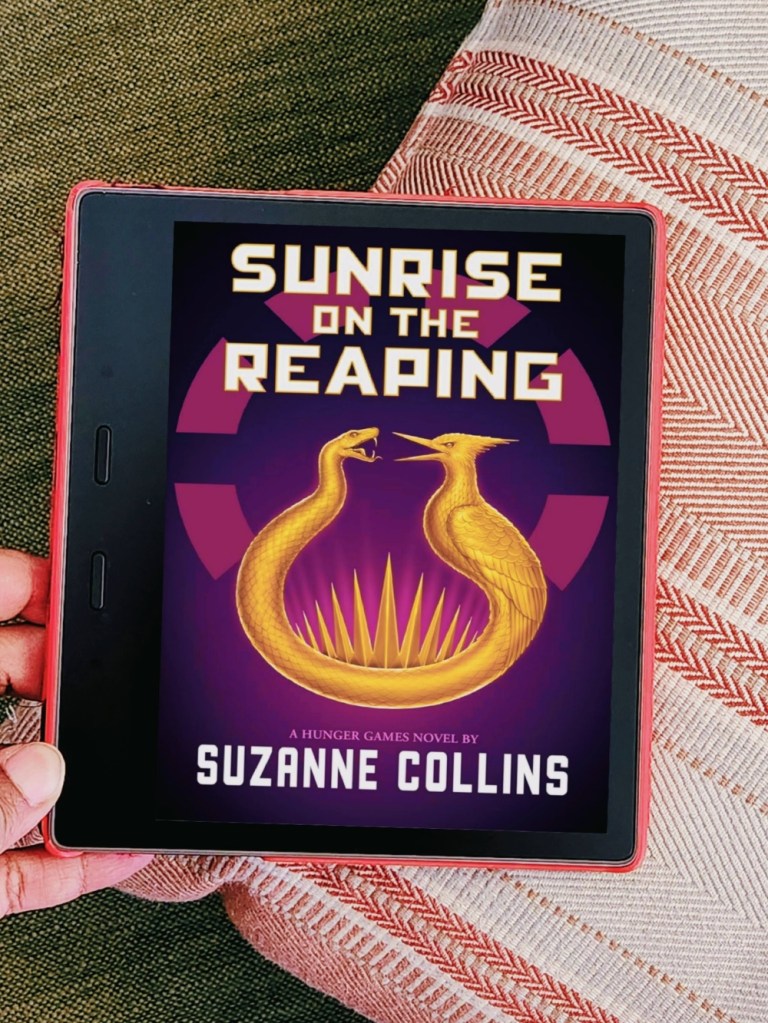
In Sunrise on the Reaping, we are taken to the 50th annual Hunger Games, or the Second Quarter Quell. This book looks at the tragedy of Haymitch Abernathy. It reveals the boy he was before the Capitol systematically broke him.
To celebrate the 50th anniversary of the Capitol’s victory, the rules dictate that twice as many tributes must be reaped. We meet a young Haymitch who actually loves his life in District 12, despite its harsh realities. He has his girlfriend, Lenore Dove, a close-knit family, and friends he cares deeply about. When he is forced to participate, his future vanishes in an instant.
Plutarch and Beetee make significant contributions in this backstory. This gives us a little insight into their actions during the revolution. May and Wiress are also on the team.
In this book, the author explores the how and why the majority of the people would submit to a cruel few. We see how Haymitch is broken down by cruelty and has resigned himself to the inevitability of the Capitol’s power. But Lenore, who dares to rebel, is ‘taken care of’. Totalitarian power seeks to crush the human spirit, and not everyone can pay the price of what it truly costs to fight back.
“Make sure they don’t use our blood to paint their posters”
The Illusion of the Arena
At its core, the series is a scathing commentary on our desensitisation to violence and the media’s power to manipulate truth. The Games themselves are a brutal reality TV show where survival is commodified. We see how the Capitol ensured that the Districts are not only punished by taking their children away, but are also forced to watch it happen.
According to Suzanne Collins, the idea came to her while channel surfing between competitive reality television programs and actual, devastating footage of the Iraq War. The lines blurred, and she realised how easily we consume human tragedy as mere entertainment. Her intention was clear: to force readers to confront the very real danger of becoming passive consumers of others’ pain. In this age of over-information, I fear her prediction has come true to a large extent.
The books ask hard questions about what we owe to each other, the illusion of choice, and how power can corrupt even the most righteous revolutions.
“They will not use my tears for their entertainment.”
Verdict: Must Read
Note: Some links are part of an affiliate program, which means that if you click on a link and buy something, I might receive a percentage of the sale at no extra cost to you.




Leave a Reply