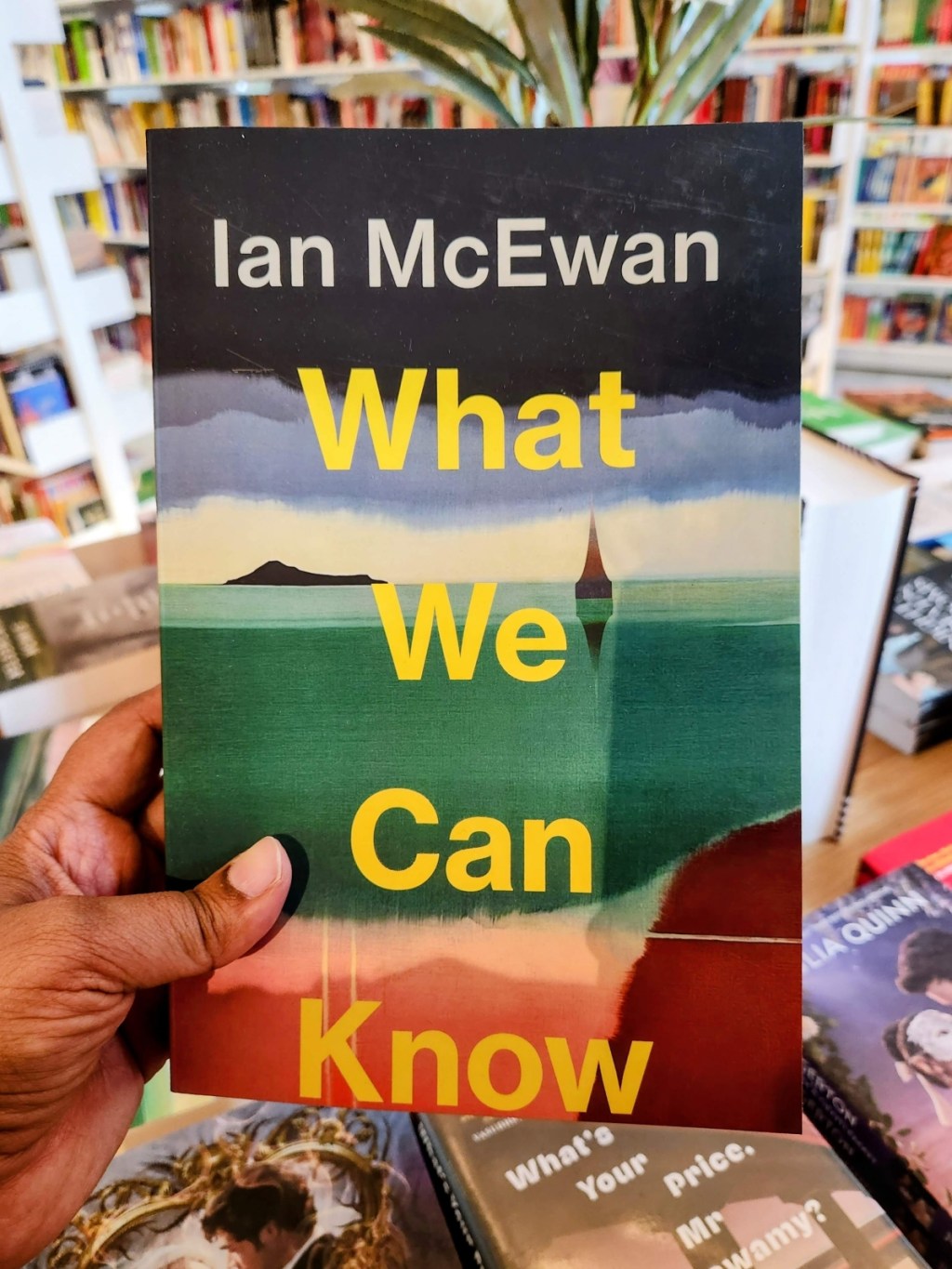
I would have never heard of this book had it not been a book club selection. Ian McEwan’s What We Can Know is probably not something I would have picked up unless it was specifically recommended to me. I started this book as an Audible, but I felt lost in the words. I didn’t understand what was happening or where the story was heading. Then I switched to reading it, and it changed my perception completely.
Let me warn you, this book is not going to give you a fully-packaged story neatly tied with a ribbon. Start reading only if you enjoy the journey as much, if not more, than the destination. The words flow beautifully and there’s much to read between the lines. Read this spoiler-free book review of What We Can Know to see if the book speaks to you.
The world we encounter in this book is set about a hundred years from now, although we get only snatches of what that world looks like. It is difficult to classify What We Can Know as sci-fi or dystopian, so I’ll just stick it in the fiction category for now.
According to Ian McEwan, “What We Can Know is science fiction without the science. This is a novel about history, and what we can know of it, and of each other. We live our lives between the dead and the yet to be born…I’ve written a novel about a quest, a crime, revenge, fame, a tangled love affair, mental illness, love of nature and poetry, and how, through all natural and self-inflicted catastrophes, we have the knack of surviving somehow…My ambition in this novel was to let the past, present and future address each other across the barriers of time.”
Author Ian McEwan
“The books in that shop can be summoned in an instant to our screens, but oh, to have wandered the aisles, thrilled to be riding the crest of newness, interest and abundance.”
Ian McEwan is a British author. He is a prolific writer and to mention all his works would take up a whole blog post. He’s won a host of literary awards. He has also been shortlisted for the Man Booker Prize for Fiction numerous times, winning the award for Amsterdam in 1998. His novel Atonement received multiple awards and was even made into a movie.
He was awarded a CBE in 2000. His articles, essays, and talks on various topics such as politics, science, and literature are widely referenced.
Book Review: What We Can Know
“‘In love, we forgot that we too were things that could get broken or lost.’”
This story is set a century from now in a climate-ravaged, technologically regressed future. The narrative brilliantly contrasts the abundance of our current century with the stagnance of the 22nd.
We follow Thomas Metcalfe, who is a writer and researcher studying the late 90s and early 2000s. He is searching for a particular poem mentioned in essays and journals of the time that is supposed to be brilliant in content and technique. The poem structure is called a corona, which is a series of sonnets on a single theme.
While he delves into the past, he also becomes a little obsessed by it. Much like many of us who long to live in Jane Austen’s world, he believes that if he had just been born in a different era, things would have made more sense.
“I foolishly convinced myself that I was living in the wrong era. I exaggerated the vitality and beauty of the past and ignored its squalor and cruelty and morbid greed. If I was transported back there, I would loathe it.”
There are many interesting threads in the story: Climate change, the rise of AI, the unpaid labour of women, a bit of suspense, and survival. It took me a while to get into the flow of the actual storyline because I got swept up in the descriptions of the new world, the old world seen through the eyes of the future, the characters, and the actual events.
Part 1 is the build-up and Part 2 of the book is where the story happens. If you feel like giving up early, please hold on. It will be worth it.
Living with the Consequences of Climate Change
“A nation is so large and full of things and ideas that it takes a lot of determined folly to ruin it all. So with the planet. We wrecked much of it, but not everything….Each time we fail, or calamities overwhelm us, we will come back from a slightly higher place. Rising and falling, we would continue to scrape through. Like one of nature’s rhythms, spring and autumn, when the earth breathes in then exhales carbon dioxide.”
The future world, as imagined by Ian, seems sedate, where their greatest achievement is simply not being at war. Everyone looks like a homogenous pale-brown race, eliminating racial divides. Stripped of human interference, the seas are cleaner, marine life is returning, and the surviving islands are lush. It is a peaceful world, but entirely devoid of new thoughts and ideas. Humanity is surviving, but it is no longer thriving.
Society has been reduced to isolated island-dwellers (the largest islands being only about 38 miles across). Real chocolate is a rare delicacy because food diversity is severely limited since most of the land is now under water. It seems like the Global North are no longer the ones holding the power.
The early 2000s are referred to as the Derangement. This is the ultimate indictment of our present day. This generation was too deluded by short-term comfort to act while there was still time and they simply let the world fall to pieces. There were also many wars for resources that led to the current isolation and militarisation of the world. Starting with Russian attack on Ukraine for land, water disputes between India and Pakistan, leading to Saudi Arabia and Israel invading Iran egged on by AI to attack.
Old low-orbit satellites crashed to Earth, taking GPS with them. With rare minerals gone, society has been forced back into the analogue world. I was reminded of the show Pluribus on Apple TV+ where the new world order again, has to rely on landlines and radio. Our digital assets (ebooks, movies on streaming, music etc) can all be altered or stripped away in an instant. Old and ‘obsolete’ technology might be the only thing that survives in the future, if only we still remember how to use it.
One good thing in this world (according to me) is that Artificial Intelligence has been taken away from Big Tech and is heavily regulated. Citizens only get small doses for relationship or financial advice (and definitely no help with homework!). This comes after many instances of over-reliance on AI leading to catastrophic consequences.
Francis and Vivien Blundy
“‘A Corona for Vivien’ remains precious for those who care, a talisman to the survivors and a promise of a better future. A poem has served history well by remaining a blank sheet.”
The plot’s driving force is Thomas’s obsession with a lost poem by the renowned poet Francis Blundy. This fascination with the poem starts with a note written by another poet who had listened to it, equating it with Keats and Wordsworth’s ‘immortal dinner’. Some documents also mentioned that it could be about climate change, which sparks the interest of many historians in this futuristic world. The search for the missing poem becomes a treasure hunt quest, giving the poem a legendary status without ever being read.
We meet our characters through emails, memoirs, journals, and other memories people have left behind. We see Vivian, who seems like a devoted wife, and Francis, a reclusive genius who is easy to hate. But on Vivien’s birthday, he decides to gift her a masterpiece that he will not publish or even make copies of. It is only for her.
He reads this poem at her birthday lunch with a group of friends and family. That’s the last anyone ever hears it. How such a brilliant piece could’ve been lost has troubled historians for years.
This story brilliantly captures how memory-keeping has shifted from the detailed, expansive journaling of the 18th century to the fragmented 21st-century methods of texts, social media, and photos. We are also faced with the thought of how much we can believe of any personal memoir. History can easily be lost, re-written, and is rarely as beautiful as we imagine it to be.
“…-the present vanished forever into the gaping mouth of the greedy past. Vivien existed only in the minds of those who thought about her. …But it was the same stream, and she was here once, looking at it, just as I was looking at it now. That our presence here, screened from each other by time, constituted a separate reality, was at the core of my obsession, and perhaps the obsession of all dedicated historians, biographers and archaeologists.”
In Part Two, the POV changes, and so does the whole perspective of the story!
“I was teaching myself to lie by omission. Most useful, for behind and ahead of me were acts that were too shocking to own.”
This novel had its origins in the technically brilliant poem by John Fuller, ‘Marston Meadows: A corona for Prue’. It is a celebration of long love and nature, and a meditation on mortality. Here’s a reading of it by TLS Editor Camille Ralphs.
Verdict: Read
Note: Some links are part of an affiliate program, which means that if you click on a link and buy something, I might receive a percentage of the sale at no extra cost to you.


 Love, Life, & Beyond
Leave a comment