

In order for me to write poetry that isn’t political
I must listen to the birds
and in order to hear the birds
the warplanes must be silent.
– Marwan Makhoul, Palestinian Poet
How do you write about an ongoing genocide? I am left speechless. So here are some books that try to bring more stories to light and give words to your feelings. A novel, a book of poems, a graphic novel, and a reality check with a non-fiction book, all on the same topic.
The world had said Never Again and at some point we became okay with Again and Again!

Book Review: Minor Detail by Adania Shibli, translated by Elisabeth Jaquette
There are some who consider this way of seeing, which is to say, focusing intently on the most minor details, like dust on the desk or fly shit on a painting, as the only way to arrive at the truth and definitive proof of its existence.
This short novel packs a punch. It is divided into two parts. The first part observes a commander in the Israeli platoon delegated to patrol near the Egyptian border in the newly-formed state of Israel. The second part is a first person POV of a woman who learns of a horrific crime that happened many years ago and becomes obsessed with finding out more details. Through her journey, we get to know the current state of the people living there, and the limitations imposed on the Palestinians. Many minor details connect the two parts—the barking dogs, the sand, a gun shot, but these details can get lost in the bigger picture.
The story starts with a mundane look into the daily routine of an Israeli army commander in the desert near the Egyptian border. They are assigned to clear the area of any Arabs before Israeli settlers can move in. His platoon finds a young nomadic girl in the area. The soldiers repeatedly rape then kill and bury her in the sand (based on a real incident).
The second part of the book takes place decades later, when a young woman in Ramallah comes across this minor detail in the history of the region and is obsessed with finding out more information. As she goes on a short journey to the scene of the crime, we see the current situation through her eyes—the fear, the restrictions, and the occupation.
sometimes it’s inevitable for the past to be forgotten, especially if the present is no less horrific
The story-telling seems deliberately mundane but the devil is in the minor details and between the lines. Adania’s writing is subtle. She does not explicitly talk about the atrocities and overwhelm you with gory details. Instead, her writing is that of an indifferent observer, narrating the events without any emotions. Most of the book has seemingly trivial details and the main act of violence is just casually mentioned, as if it were of no import.
The text can be taken at face value or the deliberate use of scenes could be interpreted to mean a lot more. For example, the obsessive Israeli commander meticulously washes his hands and cleans his tent, he even kills people with the same emotional level. The violation and death of a young Arab girl is no more to him than his basic hygiene routine.
It is our duty to prevent them from being here, and to expel them for good. After all, Bedouins only uproot, they do not plant things, and their livestock devour every bit of vegetation that lies before them, reducing, day by day, the very few green areas that do exist. We, however, will do everything in our power to give these vast stretches the chance to bloom and become habitable, instead of leaving them as they are now, desolate and empty of people.
In the second part of the story, we follow a woman who is preoccupied with minor details in everyday life. She reads of the rape and murder of a young girl exactly 25 years ago from the date of her birth. The report is a side note in an Israeli news article, which seems to her an incomplete narrative. That has been the tactic of any occupying force; to present their side of the events and suppress the voices on the other side. She feels like she is somehow linked to the young woman through the ages and so journeys to the scene of the crime.
if one wants to arrive at the complete truth, which, by leaving out the girl’s story, the article does not reveal.
But, it is easier said than done. In occupied Palestine, people who have lived on the land for centuries no longer have the right to move about the same land freely. There are checkpoints and barriers at every stage to go to the border. She needs to borrow a colleague’s ID card to visit the Israeli settlement areas and is scared of being caught for that crime.
She carries with her a map made by Palestinians and a recent one made by Israelis. She is shocked to see the drastic changes. Entire villages have been wiped out and Israeli towns and cities built over them.
the changes constantly reassert the absence of anything Palestinian
She compares her life living under occupation in Palestine to her life on this side of town. The difference ranges from the subtle to drastic. Unlimited supply of running water is a luxury but the fear is heightened as she is not in a crowd of familiar faces. When she hears bombs drop in the distance, it sounds different and doesn’t seem as urgent as in Ramallah.
Bombing sounds very different depending on how close one is to the place being bombed, or how far.
The book gives us a peek into life under occupied rule and the everyday brutality people have gotten used to. From casually opening windows so the bomb blast next door doesn’t damage them to having the threat of guns pointed at them so they have to climb back walls to get into their homes and places of work; people adjust and die or revolt and die.
The final scene is a brutal reminder how some humans are considered dispensable and don’t even get offered the dignity of an explanation.
Author: Adania Shibli was born in Palestine in 1974. Her first two novels, Touch and We Are All Equally Far From Love, were translated into English. She was awarded the Young Writer’s Award by the A. M. Qattan Foundation in 2002 and 2004.
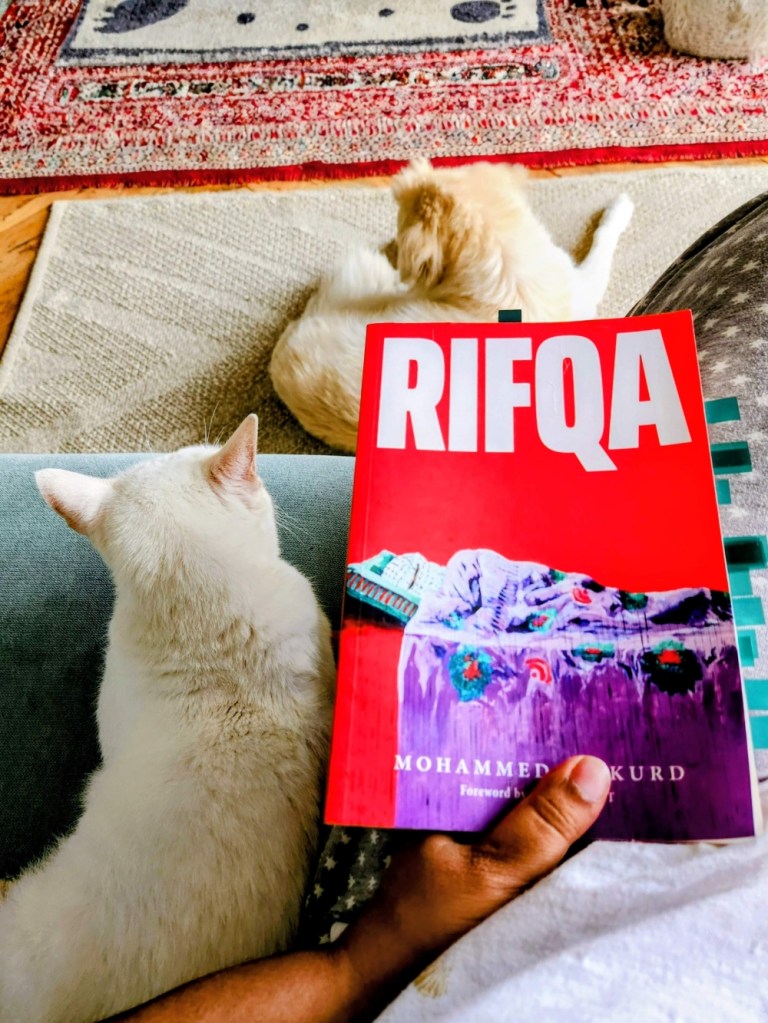
Book Review: RIFQA by Mohammed El-Kurd
In Jerusalem, every footstep is a grave.
This is a book of poems on the poet’s life, remembering his grandmother, and how he reconciles living abroad with the trauma of war on his people. It is divided into four parts talking about his early life in Palestine, the ongoing violence and deaths of Palestinians, his concept of home as he has moved to Atlanta, and how he tries to get the world to notice the Palestinian struggle.
There is strong imagery and emotion in what he writes. In the poem This is Why We Dance, he talks of his resilient people and how he fluctuates between anger and pride when he hears the news, and how the world needs to hear more of what’s happening in the world outside their bubble even if it makes them uncomfortable.
We have wounded feet but the rhythm remains,
…Because screaming isn’t free.
…Please tell me:
Why is anger-even anger- a luxury
To me?
Many poems have scattered words and are confusing to read, but it’s almost as if they are fragments of his own life. Who Lives in Sheikh Jarrah is one such poem. The fragmented words represent the censored article that was published in the New York Times. The world keeps trying to silence the voices of one side while giving power to the ones who are useful to them in power and resources.
They asked her, What’s wrong with the flower?
not What’s wrong with the rain?
One of the things he talks about is also how Americans in his daily life react to him when he mentions Palestine. In the poem, Why Do You Speak of the Nakba at the Party? He talks about how everyone just takes a one-sided view of the situation and how They cannot see you…They brought divinity to the crime scene to avoid justice.
My name: a bomb in a white room,
a walking suspicion
I don’t understand many of the references mentioned and what he means to say between the lines, but there are some events that do seem familiar from the news (like the murder of the children playing football on the beach).
on most days we weep in advance.
There have been plenty of news reports that have made it to the outside world where children have been murdered by tanks and guns for throwing sticks and stones, because they were perceived as a threat! Some poems are a tribute to those young souls.
Violence is not children taking on dragons.
Some of these reviews might give you a better understanding of the poems: Nameera Bajwa, The Markaz Review, and LA Review of Books.
I cried—not for the house
But for the memories I could have had inside it.
Of course, his grandmother, after whom the book is named, is never far away from his thoughts: From his pride of her fighting spirit, his anger at the number of times she has been displaced, and how they have a similar nose—Arrogant with height. One nose away from clouds.
Nowadays she walks fragile,
So unlike the past that she battled,
So unlike the past
Nameless faces
remembered
on her wrinkled face.
They tell the story of the particular events:
organized, plural,
ongoing.
This is a beautiful and painful collection of love, grief, resilience, and hope. YouTube has his spoken word album, Bellydancing On Wounds, with some haunting music that is worth a listen.
Author: Mohammed El-Kurd is an internationally touring poet and writer from Jerusalem, Palestine. He graduated from the Savannah College of Art and Design with a B.F.A. in Writing, where he created Radical Blankets, an award-winning multimedia poetry magazine. His album, Bellydancing On Wounds, was released in collaboration with Palestinian musical artist Clarissa Bitar. Apart from poetry and writing, el-Kurd is a visual artist, printmaker, and most recently, co-designer of a fashion collection with Serbian designer Tina Gancev. His new book, Perfect Victim is a non-fiction reflection on the on-going crisis.
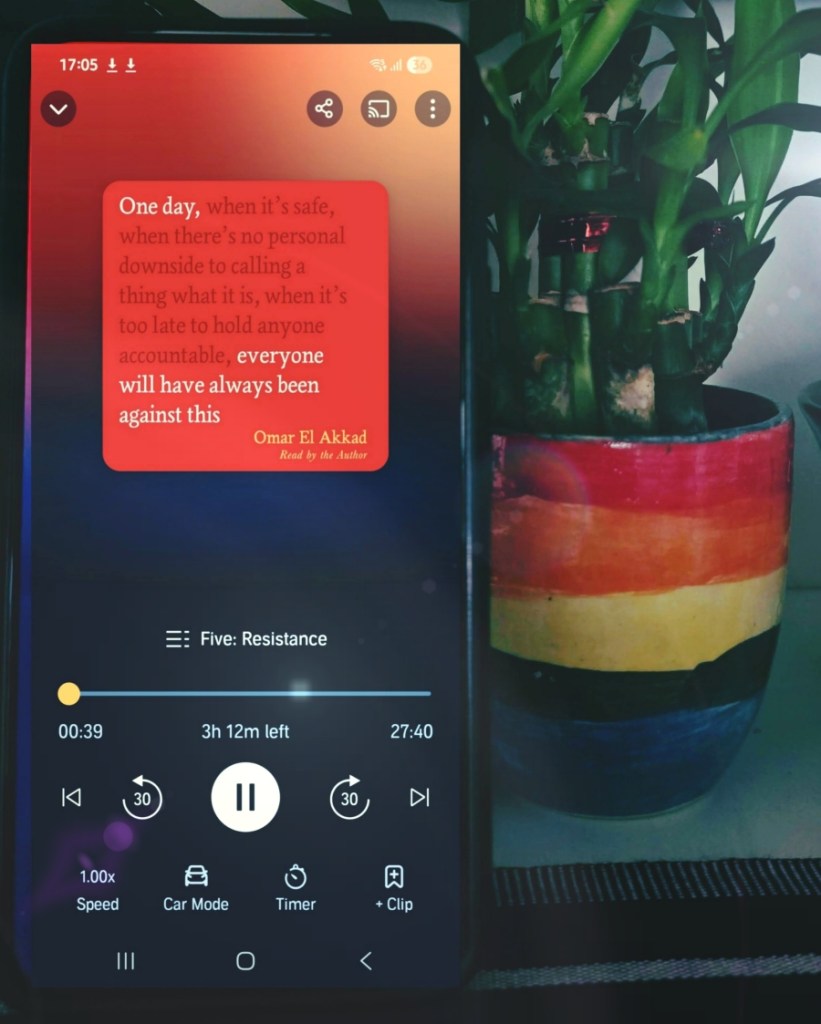
Book Review: One Day Everyone Will Have Always Been Against This by Omar El Akkad
What purer expression of power than to say: I know. I know, but will do nothing so long as this benefits me. Only later, when it ceases to benefit me, will I proclaim in great heaving sobs my grief that such a thing was ever allowed to happen. And you, all of you, even the dead in their graves, will indulge my obliviousness now and my repentance later because what affords me both is in the end not some finely honed argument of logic or moral primacy but the blunt barrel of a gun.
This book came up as a recommendation, and I’m so glad it did; otherwise, I would’ve missed it completely. The title of the book (and a lot of the content) is a sentiment I have been feeling but haven’t been able to express so clearly. It gave clarity to my muddled thoughts.
At the start, he mentions a girl pulled out of the bombed rubble of her home after several days. She is stunned and wants to know if she’ll go to the morgue, and her rescuer comforts her that she’s alive and looks like the moon. When I saw the video of it, I remember feeling how nurturing that man was. In wars, the focus is usually on women and children. We often forget that the dying men are also caregivers and gentle souls deserving of life.
How does one finish the sentence: ‘It is unfortunate that tens of thousands of children are dead, but …’
I also felt the author’s internal conflict as he wants to shield his daughter, born and raised in the Western world, from the derision she would have to deal with being an immigrant’s child. From giving her a neutral-sounding name to not telling her the true histories of his parents, it is something I’ve heard other immigrants do as well. He also hides his research on war zones from his daughter to give her a more carefree and secure childhood.
And it may seem now like it’s someone else’s children, but there’s no such thing as someone else’s children.
He talks about having to move out of Egypt, his birth country that his father loved, and living through the Gulf War. He observes how most Western countries become desensitised to conflicts in distant lands. They think it’s something that only happens in ‘third-world’ countries, without considering that it most likely started because of a ‘first-world’ country interfering for profit. I noticed this dichotomy when the Ukraine war started and Prince William made a statement that it was unacceptable that Europeans were being displaced (talk about tone deaf!).
When Omar moved to Qatar, he noticed how anyone in power anywhere on earth can treat those beneath them abysmally without consequences. He recalls an incident he witnessed where a Qatari man beat up a South Asian for daring to share the same space. As with American slavery, the workers are only useful for the work they do and have no right to exist beyond their job. They’re considered non-human.
Whose nonexistence is necessary to the self-conception of this place, and how uncontrollable is the rage whenever that nonexistence is violated?
He also highlights the difference between calling people expats or immigrants and aliens, depending on which part of the world they originate from. Qatar for expats is luxurious, whereas workers from low-income countries live without any rights, human or financial. Westerners, or expats, choose to seclude themselves in host countries amongst their own, rarely meeting any locals socially. However, it is people coming to Western countries who are blamed for not assimilating adequately in their new abodes.
Another observation he makes is that when Westerners move to live in the Global South, their lives become bigger in terms of lofty jobs, experiences, and money. But, when it is the other way around, the lives of immigrants have to become smaller. Their qualifications from their home countries no longer matter. I had met a cab driver in London who was a qualified doctor from Afghanistan, and had to leave under threat from the Taliban for treating women. But recertification in London would be too expensive and time-consuming. He had a family to feed, so he drove a cab to make ends meet.
Some things are complicated. Some things have been complicated.
There are many incidents he mentions in the book that seem all too familiar. I could feel the pain and fear in his voice as he described how American ‘peacekeeping’ soldiers accosted his father in Qatar for just returning home at night. Locals need to earn the right to exist in their own countries when colonisers come to their country ‘to help’.
It is a hallmark of failing societies, I’ve learned, this requirement that one always be in possession of a valid reason to exist.
On the subject of the Israel-Palestine conflict, he talks mostly of how the PR machinery works when disseminating information and how a genocide is justified using language that is vague and hypocritical.
One of the things he said that really resonated with me was that “The starting point of history can always be shifted such that one is always instigating, the other always justified in response”. Israel keeps justifying its genocide because of the events of Oct 2023, but ignores the violence of occupation it has been inflicting before it. Although it is well documented, it is largely ignored.
Colonialism demands history begin past the point of colonization precisely because, under those narrative conditions, the colonist’s every action is necessarily one of self-defense. The story begins not when the wagons arrive, but only after they are circled.
The book is also a jarring critique of Western liberals and American Democrats who do nothing to stop the genocide or even acknowledge it. Most liberals don’t denounce barbaric policies on moral grounds but on how the minorities are useful for them. At least Republicans are honest of their intentions, no matter how crude. Democrats have only empty gestures. After Trump won a second term, liberals were angry with minorities who voted for him. They were angry that minorities got to exercise their rights in a way they didn’t expect. Americans love the underdog story in movies, but are not self-aware enough to realise that they are the Empire.
How empty does your message have to be for a deranged right wing to even have a chance of winning?
Even the mainstream news media is mostly biased and pushes its own agenda. Journalism is now dependent on toeing the line and the business model is to incite rage, get views and business. So, instead of factual reporting, reporters report from hotel rooms about what they see on guided tours in Israel. They report on beheaded babies without proof, and even a sitting President parrots that line.
One of the hallmarks of Western liberalism is an assumption in hindsight of virtuous resistance as the only polite expectation of people on the receiving end of colonialism. While the terrible thing is happening, while the land is still being stolen, and the natives still being killed, any form of opposition is terroristic and must be crushed for the sake of civilization. But decades, centuries later, when enough of the land has been stolen and enough of the natives killed, it is safe enough to venerate resistance in hindsight.
Palestinian journalists are being killed en masse, and no one is outraged. They continue to report despite personal losses and injuries. But these reports and reporters are not given the consideration they deserve in news around the world. When it comes to the Russia-Ukraine war, everyone mentions how Russia is committing war crimes, but fails to mention the same crimes against Palestine. Everyone defers to power and the hypocrisy is unbelievable. War is profit for many, so it continues on people who can offer nothing in return.
Rules, conventions, morals, reality itself: all exist so long as their existence is convenient to the preservation of power. Otherwise, they, like all else, are expendable.
It is truly scary how he describes, “You are being asked to kill off a part of you that would otherwise scream in opposition to injustice. You are being asked to dismantle the machinery of a functioning conscience.” It is dystopian how we’re slowly allowing ourselves to distance ourselves from reality. The thing we should be worried about is how we’re being asked to not get angry at a genocide. If we don’t realise the pitfalls that lie ahead and correct course, who knows what will happen when they eventually come for us.
A world that shrugs at one kind of slaughter has developed a terrible immunity. No atrocity is too great to shrug away now, the muscles of indifference having been sufficiently conditioned.
However, there are some bright sparks in the midst of darkness. So I end with his words:
There is hope in a bleak world: The Palestinian doctor who would not abandon his patients, even as the bombs closed in. The Icelandic writer who raised money to get the displaced out of Gaza. The American doctors and nurses who risked their lives to go treat the wounded in the middle of a killing field. The puppet-maker who, injured and driven from his home, kept making dolls to entertain the children. The congresswoman who stood her ground in the face of censure, of constant vitriol, of her own colleagues’ indifference. The protesters, the ones who gave up their privilege, their jobs, who risked something, to speak out. The people who filmed and photographed and documented all this, even as it happened to them, even as they buried their dead.
It is a book that will resonate with so many who have been on the receiving end for so long. For those in positions of privilege, it is a look into an experience you would never have experienced or known possible but can lend your voice as an ally to bring more awareness and eventually some form of justice.
Author: Omar El Akkad is an author and journalist. He was born in Egypt, grew up in Qatar, moved to Canada as a teenager and now lives in the United States. The start of his journalism career coincided with the start of the war on terror, and over the following decade, he reported from Afghanistan, Guantanamo Bay and many other locations around the world. His work earned a National Newspaper Award for Investigative Journalism and the Goff Penny Award for young journalists. His novels, American War and What Strange Paradise, have won numerous accolades.

Book Review: Palestine by Joe Sacco
What kind of feeling would you have if your door was smashed down? Would it be a feeling of love? Who do we have to complain to? The soldiers?
Joe Sacco is a journalist, and instead of writing a news article about the two months he spent in Palestine, he has drawn a comic book to show us what words cannot, sometimes. The reporting is now over three decades old and things have gotten worse, but this book gives you a better understanding of the history and what the Palestinians have endured, and are enduring.
He talks of how reporting in the West is mostly one-sided and never in sympathy of the Palestinians. So, he goes there to find out for himself. Every Palestinian he meets has a tragic story to tell. There are sparks of humour in this bleak story-telling; the overdose of sugar in teas and the jokes people tell to stay sane.
Inside, glass and dozens of large stones, left there like the axe, I suppose to prove to visitors—and maybe themselves—that such things happen…
Everyone he meets wants him to know their stories, hoping that maybe someone in the outside world will care enough to make it all stop. He talks about the economic policies designed by Israel to ensure that Palestinians are kept poor and desperate. They are highly taxed and denied permits. Many travel hours everyday to work in Israeli companies for next to nothing payments.
There are many journalists and activists who come and go. How many are there to actually make a difference? Many are paraded on the PR route decided by the occupiers, showing them how they allow schools and hospitals to function. And then the world thinks it can’t be so bad.
The Occupation is crawling with do-gooders, human rights monitors, nuns and Quakers, international jurists with clipboards, all of ‘em willing to pile us high with documents and studies…But we want faces, we want pain, we want to rub up against people who’ve had the shit kicked out of them.
The stories do get graphic, especially when describing the prison tortures. If you pause to dwell on any of this, it will be difficult to carry on reading. Read it quickly and turn the page, what else can you do?
They destroyed everything. There is no sign that we ever lived there.
The plight of Ammar really moved me. All he wants is a basic shelter with a floor instead of sand and a toilet with walls, but he can’t find a job. Even then he insisted on paying Joe’s cab fare. He must snatch shreds of dignity wherever he can find it.
Of course, there are many Israeli soldiers who don’t agree with the tactics, but they cannot refuse to serve. And once they’re in the midst of it, it’s either kill or be killed. At the end, when Joe’s talking to the two Israeli women, you can see the contrast in the topics of conversation. They have the option to talk about something else other than the war and have some semblance of normalcy.
As for long-term resolution, he ends with an anecdote about a boy standing in the shade to avoid the rain. A group of Israeli soldiers take his place and he’s left out getting drenched. Is he thinking that one day everyone will be friends, or one day…one day! What becomes of someone when he believes himself to have no power?
It’s not important if we go to prison or not. This is a prison for us.
As he writes in the foreword, that both parties will continue to kill each other until the Israeli occupation is addressed as an issue of international law and basic human rights. We are yet to see that happen.
Author: Joe Sacco, one of the world’s greatest cartoonists, is widely hailed as the creator of war reportage comics. He is the author of, among other books, Palestine, which received the American Book Award, and Safe Area: Goražde, which won the Eisner Award and was named a New York Times notable book and Time magazine’s best comic book of 2000.
I use Audible for some books and they’re great to listen to.
Note: Some links are part of an affiliate program, which means that if you click on a link and buy something, I might receive a percentage of the sale, at no extra cost to you.


 Love, Life, & Beyond
Leave a comment