
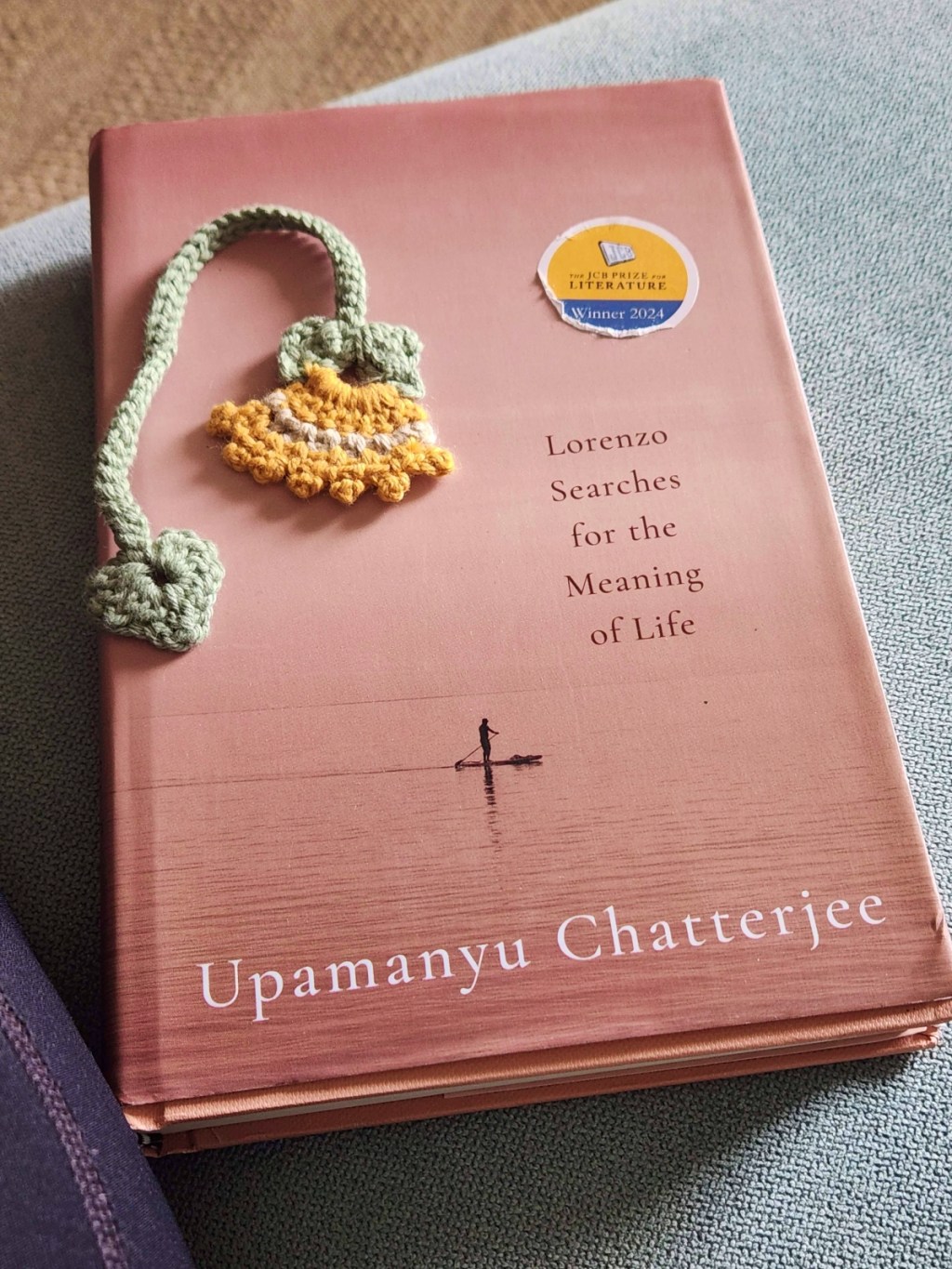
Many of us need to go far away to allow what we have left behind to become clearer
Lorenzo Searches for the Meaning of Life by Upamanyu Chatterjee was the winner of the 2024 JCB Prize. This book review traces one man’s journey from a quiet Italian monastery to the chaotic streets of Bangladesh, before settling down to a drastically different life than he imagined for himself.
This book sneaks up on you from a slow crawl to a sprint. We meet Lorenzo, a contemplative 20-year-old in a sleepy Italian town, trying to find his life’s purpose. He discovers solace in the rhythms of prayer through a church group, and the prose itself seems to slow to the pace of his meditative life. The descriptions of sunlit cloisters, hushed devotion, and the serenity of service are so immersive that I found myself longing to shed the noise of modern life and join him in that tranquil existence.
When Lorenzo’s journey catapults him from his peaceful sanctuary to the vibrant chaos of Bangladesh, the book transforms along with him. The quiet certainty of his cloistered life is replaced by the messy, urgent beauty of serving others. His desire to be useful and find purpose and meaning in his life drives him from one project to another.
What begins as a slow, almost dreamy portrait of devotion evolves into something far more dynamic—a testament to how faith, when tested by the world, can either fracture or find its truest form. It might feel like a slow read, but it is a good journey.
Author Upamanyu Chatterjee
The Father, the Son and the Holy Ghost, they all understand the importance of that first espresso.
Upamanyu Chatterjee (born 1959 in Patna) is an Indian author and a civil servant renowned for his incisive writing on bureaucracy and the absurdities of human aspiration. A former IAS officer, he brings an insider’s precision to his depictions of institutional life.
Chatterjee has written two short stories and a few novels that have been well received. His most famous novel, English, August, is a cult classic about a disillusioned civil servant. It redefined Indian English literature with its dark humour and unflinching honesty.
In 2004, he was awarded the prestigious Sahitya Akademi Award for his book The Mammaries of the Welfare State. In 2008, he was named Officier des Arts et des Lettres (Officer of the Order of Arts and Letters) by the French Government.
Book Review: Lorenzo Searches for the Meaning of Life
But fourteen hundred years of interpreting the Rule has imbued to it a suppleness, an elasticity that allows its adherents to bend, twist and crane their necks with ease, and to smile and nod without feeling guilty or sinful or deserving of a chastising thunderbolt from Heaven
Lorenzo Searches for the Meaning of Life by Upamanyu Chatterjee is a semi-fictional account of the author’s Italian friend, Fabrizio Senesi. He is depicted through the protagonist Lorenzo, who, at just 22, leaves behind his carefree youth to enter the strict and secluded Benedictine monastery of Praglia.
The early chapters lull you into the quiet beauty of monastic life—the hushed prayers, the sunlit cloisters, and a contented life. Then, the pivot: Bangladesh. Here, the narrative, like Lorenzo’s life, explodes into vivid contrast. The text mirrors his transformation. Gone is the ascetic restraint of the monastery; now, he devours food with newfound hunger and doesn’t mind indulging in some entertainment.
The way Lorenzo’s pull towards the monastic life is described made me understand why they say it is a calling. Even amid revelry, his mind kept going back to quiet contemplation in the monastery. He tries to be a part of society, and even trains to help the elderly, but he is not satisfied that it is his life’s purpose. He finds peace only when he is dedicating his hours to quiet contemplation and routine. Then, all of a sudden he’s given the chance to move across the world.
He reflects on the distinction between eremitic and coenobitic ways of living. One is a life of a hermit who lives a secluded life and the other is one who lives among a community. Lorenzo feels that faith cannot thrive in isolation; it must grapple with the complexities of shared existence.
His training comes in handy when he moves to Bangladesh. He starts by serving as a religious guide for the local community, but he feels he can contribute a lot more to those who have been marginalised by society because of physical deformities. He starts a clinic then moves on to fundraising and even starts a family of his own.
Throughout his journey, he reinterprets the messages from his faith according to what he feels he should do. He remains the same person, though, still searching for what is meaningful for him, as the circumstances around him change. The author sneaks in a comment about how the school and living conditions he was immersed in no longer seem up to the mark for Lorenzo’s children, prompting him to accept financially-viable job opportunities.
This is how many people justify their actions in the context of their religions. Sometimes religious texts are taken too literally, and sometimes bent for convenience. We forget that these texts are from a different time and were meant to serve as guidelines, not rules. Lorenzo’s thoughts and actions will make you reflect on your own choices.
There were some key moments that resonated with me. One was where he describes how the Bangladeshi travellers from London felt a collective sense of relief as soon as they touch ground in their home country. The other is Lorenzo’s relationship with his sister Paola, which is businesslike. Once the last thread of relationship is broken after their father’s death, there seems to be no need to keep in touch. That’s the story with so many families where siblings become strangers as they grow older.
What I felt was lacking was the emotion and thought process behind Lorenzo’s major decisions. Especially when he decides to quit his priesthood and get married seems quite abrupt. I would’ve liked to know more about his inner monologue as he grappled with his decision. If the book is about his search for the meaning of life, then there needs to be more information about how he went about finding it.
Missing is worse than being killed in action. Missing is a wound that doesn’t heal; in it festers hope.
Verdict: Read
Note: Some links are part of an affiliate program, which means that if you click on a link and buy something, I might receive a percentage of the sale at no extra cost to you.



 Love, Life, & Beyond
Leave a comment