
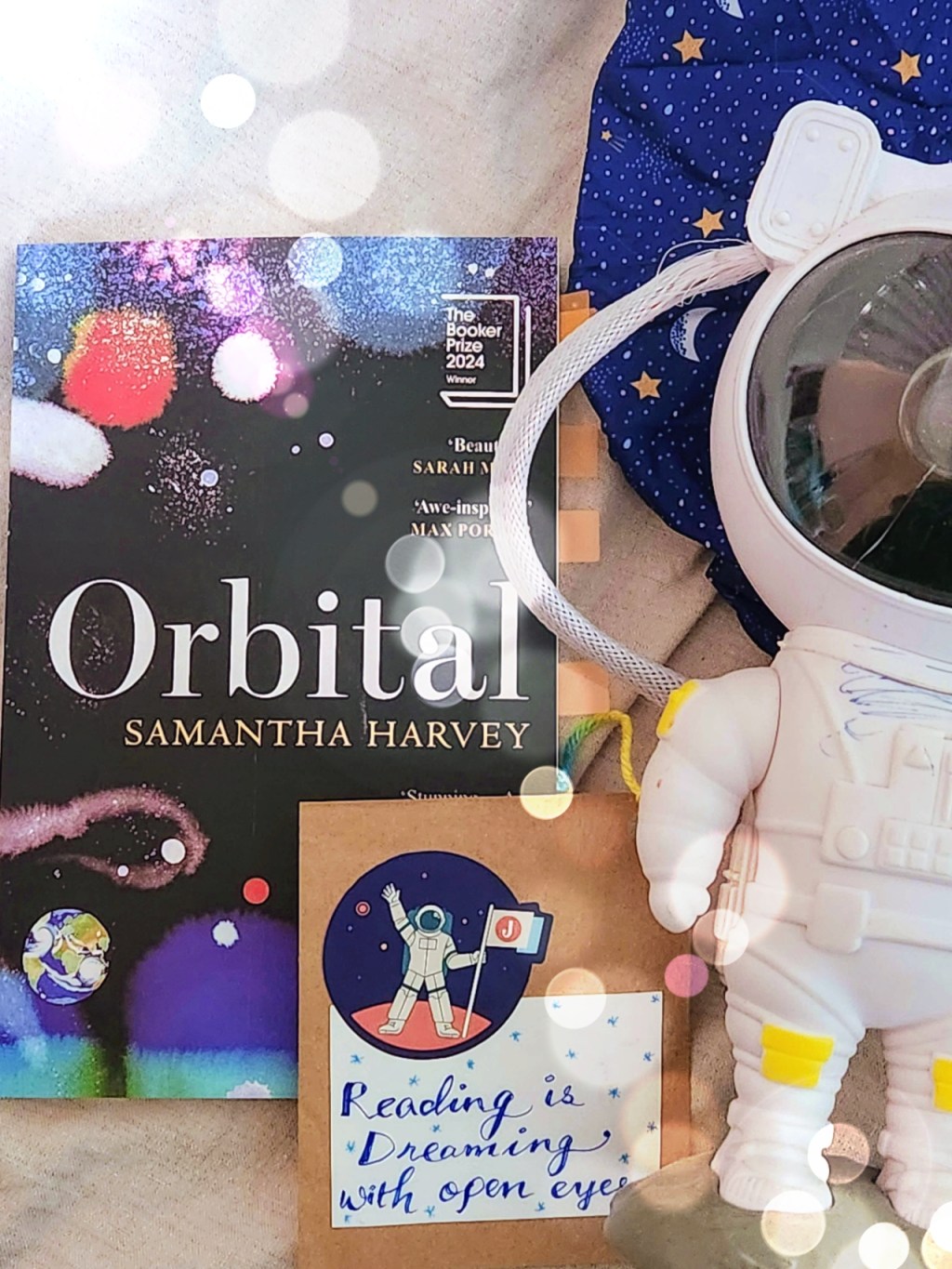
The earth is a mother waiting for her children to return, full of stories and rapture and longing.
Samantha Harvey’s Orbital is an exploration of the fragile beauty of existence, all seen from the vantage point of space. This slim yet profoundly impactful novel takes readers on a journey with six astronauts aboard the International Space Station (ISS) as they orbit the Earth 16 times in a single day. Through them, Samantha Harvey reflects on the interconnectedness of life and the fragility of our planet.
Orbital is a must-read for anyone who has ever gazed at the night sky and wondered about their place in the universe. I never really took time to think about what a person in space would think and feel once the initial high wears off. This book paints a picture of a surreal and repetitive existence, where the lack of gravity and the monotonous nature of daily tasks strip life down to its bare essentials.
Do read my book review of Tomb of Sand by Geetanjali Shree—a previous Booker Prize winner.
Author Samantha Harvey
Without that earth we are all finished. We couldn’t survive a second without its grace, we are sailors on a ship on a deep, dark unswimmable sea.
Samantha Harvey is a British novelist and academic renowned for her lyrical prose and philosophical depth of human experience. Born in 1975 in Kent, England, she spent her teen years shuffling between Ireland, York, and Japan.
Her debut novel, The Wilderness, was shortlisted for the Women’s Prize for Fiction and the Man Booker Prize. Her subsequent novels, including All Is Song, Dear Thief, and The Western Wind, have been widely acclaimed for their emotional resonance and narrative innovation. Her 2023 novel, Orbital, won the 2024 Booker Prize.
In addition to her writing, Harvey is a lecturer in Creative Writing at Bath Spa University and has contributed essays and articles to various publications.
Book Review Orbital
…and then another day they look into the face of one of those five people and there in their way of smiling or concentrating or eating is everything and everyone they’ve ever loved, all of it, just there, and humanity, in coming down in its essence to this handful of people, is no longer a species of confounding difference and distance but a near and graspable thing.
Orbital by Samantha Harvey follows four astronauts and two cosmonauts as they orbit Earth, observing a massive cyclone forming over East Asia. Through their POVs, we gain insight into their past, their motivations, and relationships on Earth and their ‘floating family’.
The novel’s structure mirrors the astronauts’ orbit, with each chapter representing one pass around the Earth. This cyclical rhythm creates a sense of both timelessness and urgency, as the characters witness the planet’s wonders—auroras, storms, city lights—and its tragedies—war, environmental destruction, and inequality.
It took me a while to orient myself within the setting of outer space. I feel we often view space exploration as glamorous, filled with excitement and cutting-edge science as depicted on screen. However, it can get quite mundane and limited I would imagine as they float in the isolating void of space.
The journey that Orbital takes us on balances the macro and the micro experience for the reader. On one hand, it’s a sweeping, cosmic meditation on humanity’s place in the universe. On the other hand, it’s a deeply personal story about the astronauts themselves—their fears, dreams, and memories. Their reflections on love, loss, and the passage of time add emotional depth to the novel musings.
…there’s no point in building something better, it’s easier to have nothing much to lose than to keep losing something.
Some things that stood out for me were the physical and psychological stress of space travel. The idea of eating food without texture day in and day out, and of a body continuously adapting to a weightless state, was unsettling for me. The descriptions of life inside the spacecraft induced a sense of claustrophobia in me, while the descriptions of the vastness outside provoked agoraphobia! How overwhelming it must be to experience this eerie contradiction in reality, and to feel both at the same time!
The spacewalk scene, in particular, made me pause and imagine the terror and awe of stepping into the endless void as if I were hovering thousands of miles above the planet. What Nell’s father pointed out to her resonated with me: That the only people who could survive space travel are those who can imagine limitlessness. I would be, like her father, the person they would have no choice but to put down so that they could continue their journey to Mars.
There are people like him (so he says) who complicate their inner lives by feeling too much all at once, by living in knots, and who therefore need outer things to be simple. A house, a field, some sheep for example. And there are those who manage somehow, by some miracle of being, to simplify their inner lives so that outer things can be ambitious and limitless. Those people can swap out a house for a spaceship, a field for a universe.
I also wondered how cohesive the team needs to be—what happens if you don’t like someone in a place where escape is impossible? Through the inner narratives of the space travellers, we are also made to consider larger philosophical questions like the insignificance of political conflicts when viewed from space, the absurdity of war driven by greed and power, and the beauty of a world without human-imposed borders.
The author also points out that even though the Russians and Americans have their differences on land, it is laughable to continue that enmity in space. Everything and everyone depends on each other. How futile it seems to hate someone for trivialities.
Because of ongoing political disputes please use your own national toilet.
Samantha Harvey also makes the reader think about the roles of humans and robots in space exploration. While technology allows robots to collect data for us, they cannot experience the wonder, grandeur, or fear that every human would feel.
But what would it be to cast out into space creations that had no eyes to see it and no heart to fear or exult in it?
The prose put me in a trance and is almost meditative, guiding the reader through the repetitive routines of life in space while making them introspect on their humanity and the paradox of feeling both, infinite and small.
Orbital is a novel that lingers in the mind long after the final page, making you appreciate both the extraordinary and the mundane aspects of human life—on Earth and beyond. Its strength lies in its ability to evoke a sense of wonder and introspection.
Verdict: Must Read
The future of humanity? Pietro says.
Yep. How are we writing it?
With the gilded pens of billionaires, I guess.
Note: Some links are part of an affiliate program, which means that if you click on a link and buy something, I might receive a percentage of the sale at no extra cost to you.




 Love, Life, & Beyond
Leave a comment