

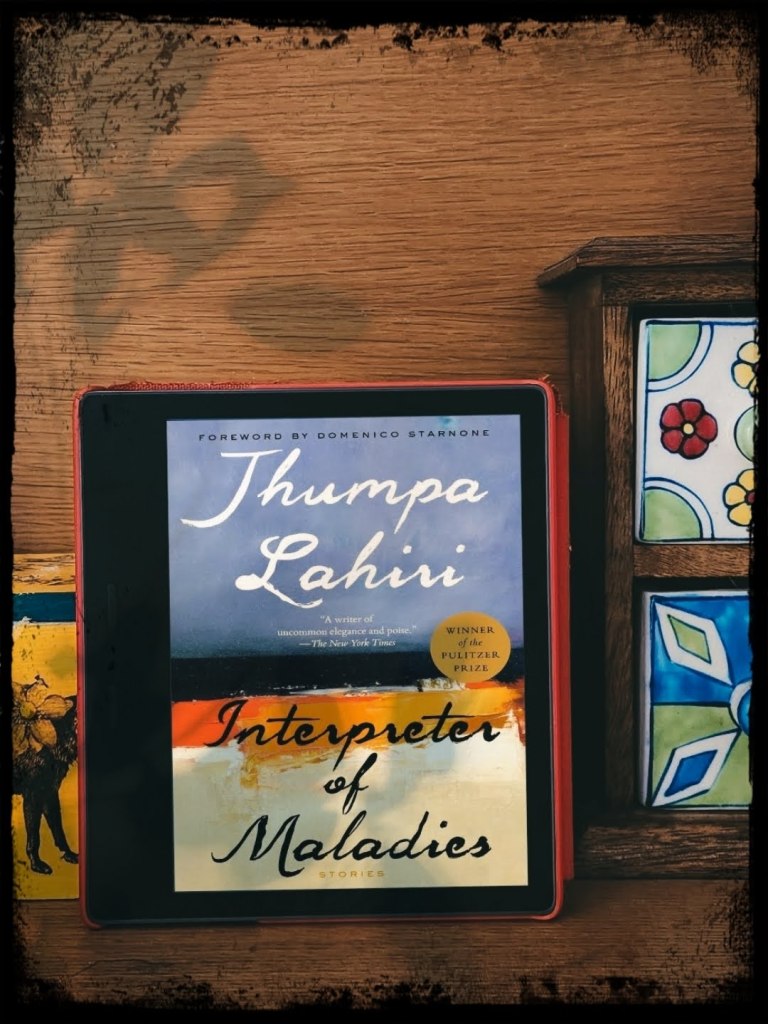
Jhumpa Lahiri’s Pulitzer Prize-winning book, Interpreter of Maladies, has been on my to-read list for ages! I finally got around to reading it and this is my Interpreter of Maladies review. It is one of the best short story collections I have read in a while. This collection of nine short stories beautifully encapsulates complex human relationships, cultural disconnection, and the unspoken emotions that shape all our lives. Through these stories, she paints a vivid portrait of the immigrant experience and the quiet struggles of identity and belonging.
The writing style is simple but conveys a strong emotional depth. She evokes powerful imagery and a feeling of nostalgia through the experiences she shares. A recurring theme in Interpreter of Maladies is the tension between tradition and modernity. Characters grapple with their identities as immigrants straddling two cultures. It is easy to empathise and sympathise with the characters.
I enjoyed each of the short stories. My favourite has to be The Third and Final Continent, with A Temporary Matter coming a close second. Every story is so well crafted that it is no wonder this debut book won her the Pulitzer Prize for Fiction.
Author Jhumpa Lahiri
Jhumpa Lahiri is an acclaimed Indian-American author and translator, celebrated for her exploration of identity, displacement, and the immigrant experience. Born in London in 1967 to Bengali parents and raised in the United States, Lahiri’s multicultural background deeply informs her work. Her debut short story collection, Interpreter of Maladies (1999), won the Pulitzer Prize for Fiction, establishing her as a major literary voice.
Lahiri’s other notable works include the novels The Namesake (2003), which was adapted into a critically acclaimed film, and The Lowland (2013), a Booker Prize and National Book Award finalist.
In recent years, Lahiri has immersed herself in Italian literature and language, authoring works like In Other Words (2016) and Whereabouts (2021) in Italian before translating them into English. Her dual identity as both writer and translator continues to expand her literary legacy.
In 2001, she married Alberto Vourvoulias-Bush, a journalist who was then Deputy Editor of TIME Latin America Lahiri currently lives in Brooklyn with her husband and two children. She has been a Vice President of the PEN American Center since 2005.
Short Story 1: A Temporary Matter
The cosmetics that had seemed superfluous were necessary now, not to improve her but to define her somehow.
A touching story of a couple grappling with the devastating loss of their stillborn baby. At first glance, they seem like a typical married pair drifting apart. However, as the layers of their grief and unspoken resentment unfold, it becomes clear just how deeply their shared trauma has shaped their relationship.
During a series of evening power outages, they attempt to bridge the emotional chasm between them, sharing secrets and vulnerabilities under the cover of darkness. But as they rediscover pieces of each other, an unexpected revelation changes everything, making you think about the fragility of human connections.
Short Story 2: When Mr. Pirzada Came to Dine
Most of all I remember the three of them operating during that time as if they were a single person, sharing a single meal, a single body, a single silence, and a single fear.
This charming glimpse into university life brought to mind a friend’s experience with South Asians forging a sense of community in a foreign land. The story beautifully captures the shared worry of leaving loved ones behind in their homeland, while offering only moral support to one another—a bond so unique to the immigrant experience.
It also subtly highlights the bubble of the American education system, which often fails to foster curiosity about life beyond its borders. Through the eyes of the young protagonist, we see how a stranger is welcomed and becomes part of the family in many ways till he is reunited with his own.
Short Story 3: Interpreter of Maladies
Maladies, poorly interpreted, can’t be cured.
Mr. and Mrs. Das are from the US and on a holiday in India with their kids. Mr. Kapasi is their tour guide and the story revolves around his observations of and interactions with the family.
It’s funny how Mr. Kapasi initially observes Mr. and Mrs. Das, likening them more to siblings of their children than their parents. This subtle detail underscores the cultural gap between traditional Indian parenting styles and the more casual, hands-off approach of some parents abroad.
The story also sheds light on societal hierarchies in India, particularly the tendency to look down upon certain professions, despite their importance. Perhaps most striking is how Mr. Kapasi misinterprets Mrs. Das’s simple gestures of politeness and need for catharsis, projecting deeper meaning onto them—showing how easily intentions can be misconstrued.
Short Story 4: A Real Durwan
Knowing not to sit on the furniture, she crouched, instead, in doorways and hallways, and observed gestures and manners in the same way a person tends to watch traffic in a foreign city.
This story is a sobering reminder of the triviality of life for the poor in India, where circumstances can shift against them in an instant. Boori Ma, likely a refugee who once lived a life of comfort, now survives by sleeping on the stairs of a modest building, tolerated by the residents in exchange for her work as an informal caretaker.
As the tenants grow increasingly obsessed with upgrading their building to improve their social standing, their attitudes towards Boori Ma begin to shift. When a robbery occurs during her brief absence, she becomes the scapegoat, accused of betraying the residents by revealing their secrets to the thieves. Her tragic downfall starkly illustrates how the marginalised are often used, discarded, and blamed, their humanity overlooked in the pursuit of self-interest. The story highlights the cruel dynamics of social hierarchies.
Short Story 5: Sexy
Sexy means loving someone you do not know.
Cross-cultural romance often carries a certain allure—Westerners fascinated by the exotic, while many Asians see a relationship with a White partner as a mark of status or achievement. This short story explores these dynamics through the story of Miranda, a young woman entangled in an affair with Dev, a married Indian man.
At the same time, Miranda observes her Indian co-worker navigating her cousin’s heartbreak as she confronts her own husband’s infidelity. The turning point comes when Miranda babysits the cousin’s young son, whose innocent yet profound words force her to reevaluate her relationship with Dev. She realises that the affair, far from fulfilling her, is keeping her from the happiness and respect she truly deserves.
Short Story 6: Mrs. Sen’s
Everything is there.
This short story captures the struggle of immigrants reminiscing about their homeland while trying to find a sense of belonging in a foreign country. Mrs. Sen’s vivid descriptions of Indian food, colorful saris, and the rhythm of life back home highlight her deep attachment to her past, making it clear she is more rooted in memories than her present reality.
Her struggles with learning to drive show her fear and low confidence in adapting to an unfamiliar culture. Through Eliot’s eyes, we see the contrast between Mrs. Sen’s hesitations and his mother’s effortless confidence behind the wheel. This hints at the challenges faced by many immigrant women learning to be self-reliant versus women who have grown up with a sense of independence. He also notes the lack of physical intimacy between the husband and wife.
For women who are deeply reliant on family, community, and familiar routines in their home countries, adjusting to life in a foreign land can be isolating and daunting. Lahiri masterfully portrays this tension, offering a heartfelt exploration of identity, dependency, and the complexities of starting over in a new world.
Short Story 7: This Blessed House
She was like that, excited and delighted by little things, crossing her fingers before any remotely unpredictable event, like tasting a new flavor of ice cream, or dropping a letter in a mailbox. It was a quality he did not understand. It made him feel stupid, as if the world contained hidden wonders he could not anticipate, or see.
In this charming short story, a newly married couple has moved into a new house and are discovering their home and each other’s personality. Sanjeev is a reserved, practical man, deeply conscious of societal norms and his professional image. Twinkle, on the other hand, is whimsical and free-spirited, finding joy in the unexpected treasures—Christian trinkets and statues—left behind by the house’s previous owners.
While Twinkle’s fascination with these objects delights her, it frustrates Sanjeev, who finds her carefree nature at odds with his more conventional outlook. However, a colleague’s casual admiration of Twinkle as “wow” prompts him to see her in a new light. Gradually, Sanjeev begins to tolerate, if not fully embrace, her exuberance, hinting at the compromises and adjustments that define many relationships.
Short Story 8: The Treatment of Bibi Haldar
Bibi had never been taught to be a woman.
The story sheds light on the stigma and neglect faced by those with disabilities, particularly mental illnesses that remain undiagnosed and untreated. Bibi Haldar, an outcast in her community, is seen as a burden rather than a person deserving care and compassion. Even though she is cared for by some women around her, they are glad she’s not their responsibility.
In India, marriage is often viewed as a catch-all solution to life’s challenges. However, her cousin, with whom she lives and depends on, has no intention of bearing the financial or social responsibility of arranging a marriage for her. Instead, she is marginalised further, kept away from auspicious events and celebrations due to superstitions about her condition.
Yet, in a twist of fate, Bibi’s life takes an unexpected turn, defying the odds and the constraints placed on her by society showing how life can unfold in the most unpredictable ways.
Short Story 9: The Third and Final Continent
While the astronauts, heroes forever, spent mere hours on the moon, I have remained in this new world for nearly thirty years. I know that my achievement is quite ordinary. I am not the only man to seek his fortune far from home, and certainly I am not the first. Still, there are times I am bewildered by each mile I have traveled, each meal I have eaten, each person I have known, each room in which I have slept. As ordinary as it all appears, there are times when it is beyond my imagination.
This beautifully layered short story explores the cultural contrasts between India, London, and the United States, from daily rituals like tea-making to the chaos of traffic and the novelty of grocery shopping in a new land. The protagonist’s journey reflects not just a physical migration across continents but also an emotional evolution as he adapts to life in unfamiliar surroundings.
A key element of the story is his tender and evolving relationship with his elderly landlady, Mrs. Croft. Her eccentricities remind him of his own mother, and this connection fosters a patience and kindness in him that her previous tenants lacked. When his wife, Mala, joins him in the US, he is initially uncertain about how she will adjust to a foreign land and a life built entirely around him.
In a poignant moment, he introduces Mala to Mrs. Croft, an encounter that becomes a bridge between their old and new lives. This shared experience brings the couple closer, helping them navigate their initial awkwardness and grow into their relationship with a newfound sense of understanding and comfort.
Audible Performance Review
While the overall narration of the Interpreter of Maladies by Matilda Novak is excellent, the dialogue—particularly the attempt at the Indian accent—leaves much to be desired. It takes away from the authenticity of the performance. Small but significant mispronunciations, like saying Ta-go-re instead of Ta-gore, highlight the need for native (or at least trained) speakers who can bring cultural accuracy and nuance to the narration. This would greatly enhance the listening experience.
Verdict: Read
Whether you’re a fan of character-driven narratives or enjoy stories that explore the intersection of culture and emotion, Interpreter of Maladies by Jhumpa Lahiri is a book that deserves a place on your reading list.
Note: Some links are part of an affiliate program, which means that if you click on a link and buy something, I might receive a percentage of the sale at no extra cost to you.





 Love, Life, & Beyond
Leave a comment