
“You could say, Oh, what a horrible time this is! and then it will go ahead and make things even more horrible. And no one will say, but these are good days, acche din! Except for the government, that is.”
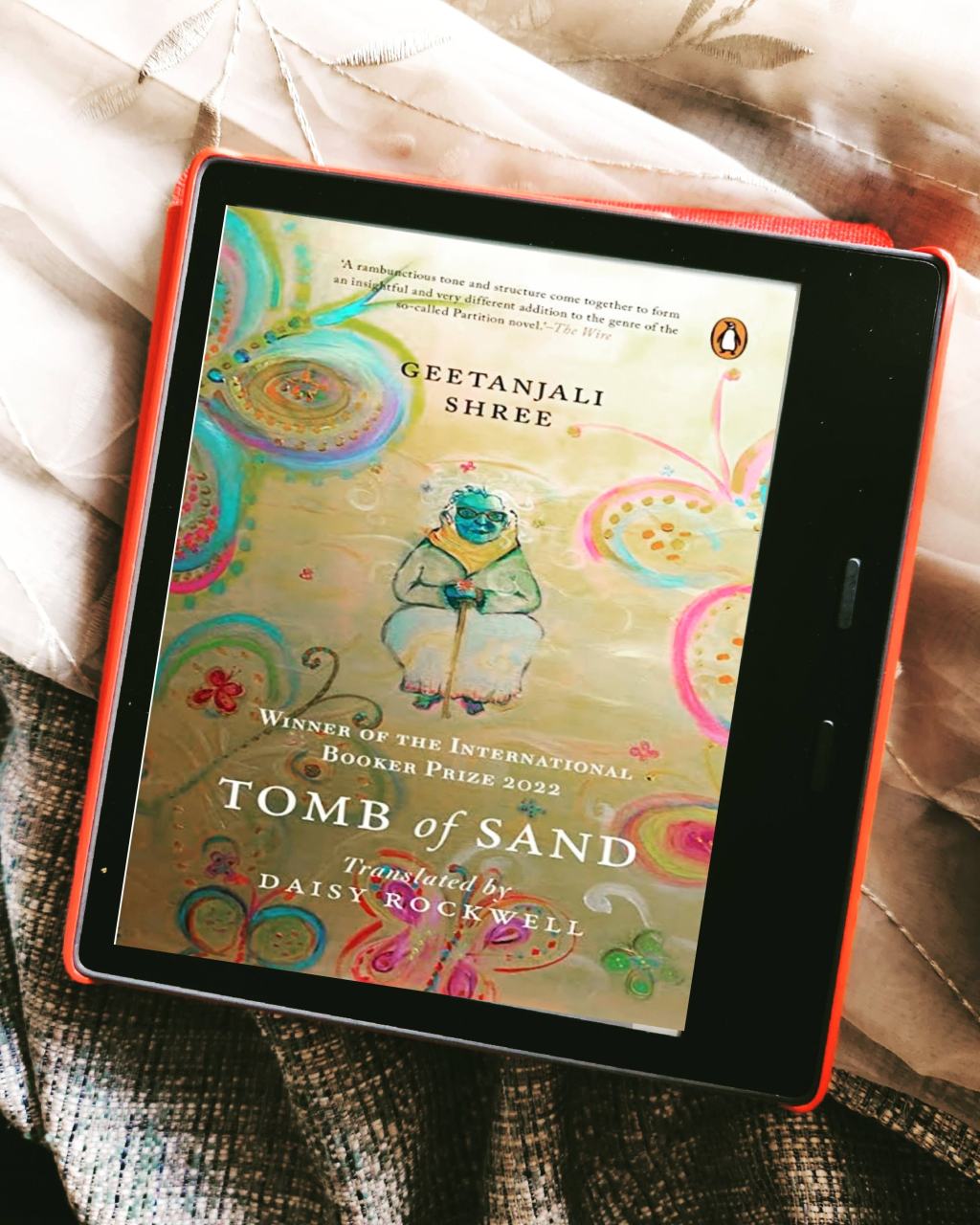
There are books that tell you a story, and then there are books that take you on a journey. The latter might not be for everyone. It needs to be read at the right time and frame of mind. Tomb of Sand by Geetanjali Shree is one such journey I undertook last month.
From beginning to end (and there sure are a lot of pages in between), not a lot happens in the story but at the same time, so much is happening. It is a story about family dynamics, old age, embracing life, and so much more.
It revolves around three central characters, Ma and her two children, Bade and Beti. We understand them through each others’ eyes and thus find out more about their own journeys.
Tomb of Sand won the International Booker Prize in 2022—the first translated South Asian novel to win it. It is undoubtedly a long read, over 600 pages, and it might seem tempting around the halfway mark to just stop. I would have too, but the beautifully written prose kept me going and it was worth it in the end.
“This is why it’s difficult to bring progress to places like Israel and Italy, because as soon as you take out a spade to build some fresh new invention, centuries past start peeping through—an ear or a nose, even the eye of Jesus, and the faith of the faithful is restored.”
The Author: Geetanjali Shree
Born in 1957, Geetanjali Shree is a Hindi novelist and short story writer based in New Delhi, India. She has written several short stories and three novels, and her work has been recognised by awards and international translations.
Bel Patra was her debut work, however, it was the English translation of her novel Mai that brought her widespread fame. Mai explores three generations of women in a North Indian middle-class family and has been translated into multiple languages. Her second novel, Hamara Shahar Us Baras, is set in the aftermath of the Babri Masjid demolition.
Originally written in Hindi as Ret Samadhi, Tomb of Sand was translated into English by Daisy Rockwell.
Daisy Rockwell is an artist, writer, and translator living in New England, USA. Her highly acclaimed translations include, Upendranath Ashk’s Falling Walls and Bhisham Sahni’s Tamas.
“A border does not enclose, it opens out. It creates a shape. It adorns an edge. This side of the edging blossoms as does that. Embroider the border with a shimmering vine. Stud it with precious stones. What is a border? It enhances personality. It gives strength. It doesn’t tear apart. A border increases recognition. Where two sides meet and both flourish. A border ornaments their meeting.“
Tomb of Sand Book Review
The narrative follows the odyssey of an 80-year-old woman named Ma, whose world is clouded by grief following her husband’s demise. Motivated by an inner resolve, she finally restarts her interactions with the world, especially with a transgender woman named Rosie.
Bade and Beti are bewildered by their mother’s new-found enthusiasm for life. Ma’s descent into profound depression after her husband’s passing is contrasted with her eventual resurgence and fervent embrace of a newfound vitality.
After having lived most of her life on the terms dictated by others, a motivated Ma embarks on a poignant journey to Pakistan, aiming to confront and reconcile the lingering scars of her teenage survival during the Partition riots.
It is an immersive novel that delves into the complexities of human relationships and the lingering influence of the past on the present. It also talks about the limits society places on us and we ourselves get so used to living within our bounds that we don’t question it. We get used to these limits and divisions based on irrelevant factors.
Ma goes into depression after her husband dies and refuses to even turn her face from the wall she faces everyday. It’s what most Indian women would feel, who are raised to be just wives and mothers. When those duties are done, they are lost and don’t know how to live for themselves.
We also see the family dynamics, where the elder son feels he is the Man of the House and should be responsible for taking care of his mother, and takes pride in it. When Ma shifts with her independent daughter, it is she who feels that she is the better child for it is in her house that Ma has started taking interest in life once again. However, she also feels stifled with that responsibility.
Geetanjali’s writing is almost poetic at times. The way she describes the sun following Ma in the day makes you feel warm and cosy. She also casually throws in deep truths like:
“Why are the only correct answers the ones you know?” or “You go where poverty takes you.”
The author doesn’t shy away from raising issues of government inadequacies and mentions various actual incidents that happen in the story’s timeline as if they’re mere distractions.
Geetanjali has sewed together many different themes into a beautiful blanket. However, as I mentioned earlier, it can try your patience at times. I took my time reading it, and got back to it when I had the patience to enjoy reading it and not just find out what happens next. A lot of the story is non-linear and often seems to drift off on a tangent, but then she brings you back where you started and things make sense again.
I would say the book is a Must-Read, not just for the story but also the story-telling, but I also understand not everyone will survive till the end.
Verdict: Read
“But there’s no shortage of stories in life, and perhaps one day I too will be in the middle of one. There’s a moon in the sky that throws off an unearthly light. What a beautiful night it is. The gentle breeze blows, whistling softly. It’s a night full of shadows and gleaming moonlight. Stories spin by: where will they cast their net?”
Note: Some links are part of an affiliate program, which means that if you click on a link and buy something, I might receive a percentage of the sale, at no extra cost to you.




 Love, Life, & Beyond
Leave a comment